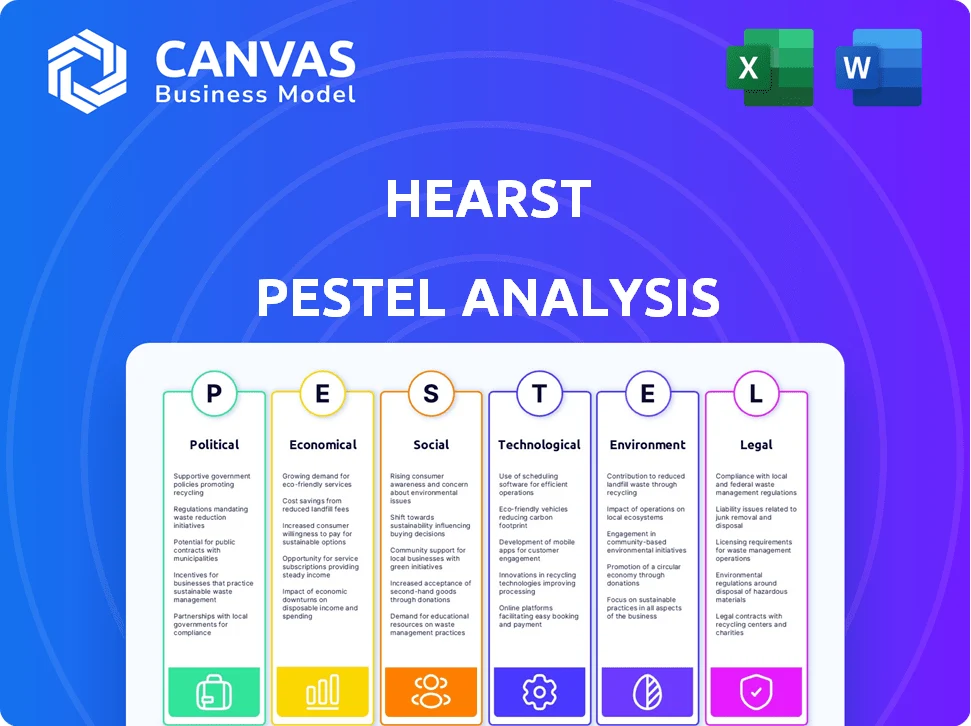
HEARST PESTLE ANALYSIS TEMPLATE RESEARCH
What is included in the product
 Detailed Word Document
A PESTLE analysis of Hearst examines external factors influencing the company's strategies.

 Customizable Excel Spreadsheet
Easily shareable summary format ideal for quick alignment across teams.
What You See Is What You Get
Hearst PESTLE Analysis
This is a glimpse of the comprehensive Hearst PESTLE Analysis. The layout and information in this preview are identical to the complete document. You will get the fully formatted version, immediately after purchase.

PESTLE Analysis Template

Your Competitive Advantage Starts with This Report
Explore Hearst's strategic landscape with our concise PESTLE Analysis. We delve into the external factors impacting their operations, from political shifts to technological advancements. This snapshot reveals key opportunities and potential risks. Our analysis is ideal for strategic planning and market assessment. Download the complete report now and gain in-depth intelligence.
Political factors

Government Regulation and Media Freedom
Government regulations heavily influence media companies via content, ownership, and distribution rules. Net neutrality and digital discrimination regulations create legal hurdles, impacting content delivery. The European Media Freedom Act, effective August 2025, aims to protect media independence within the EU. For example, in 2024, EU media markets saw significant shifts due to these evolving regulations.
Political Advertising Cycles
Political advertising cycles significantly impact media companies like Hearst. The 2024 US election boosted ad revenue, especially in TV and radio. Spending reached record levels, with over $11 billion spent. However, a substantial revenue decline is projected for 2025, as political spending typically decreases post-election. This cyclical nature requires strategic planning.

Geopolitical Events and Stability
Geopolitical instability significantly impacts media firms like Hearst. Conflicts and political tensions can restrict media freedom and safety for journalists. According to the 2024 World Press Freedom Index, many regions show declining press freedom. The Committee to Protect Journalists reported that as of December 1, 2023, at least 281 journalists were imprisoned worldwide.

Antitrust Enforcement and Big Tech Regulation
Antitrust enforcement and regulations targeting Big Tech are intensifying. These actions could reshape the digital advertising landscape, impacting content distribution significantly by 2025. Regulatory interventions are expected to alter how media outlets engage with major tech platforms in the coming years. This will affect Hearst's digital strategy.
- EU fines on Google for antitrust violations: $5 billion.
- US antitrust lawsuits against Google and Meta: Ongoing.
- Projected growth in digital ad spend: 8-10% annually.
Political Pressure and Polarization
Political factors significantly influence Hearst's operations. News organizations, including Hearst, navigate challenges from political pressure and increasing polarization, impacting audience trust and potentially leading to restrictive measures. Populist rhetoric often targets journalists. For example, in 2024, media trust hit historic lows in several countries.
- Media trust decline: A 2024 Reuters Institute study showed significant drops in media trust across various nations, reflecting political polarization's impact.
- Regulatory scrutiny: Increased government oversight of media, particularly regarding content and ownership, poses risks.
- Misinformation campaigns: Politically motivated disinformation campaigns challenge journalistic integrity and credibility.
Political Winds: Shaping Media's Future
Political elements greatly influence Hearst's performance. Government rules impact content and distribution. Ad spending varies with election cycles. The decline is expected in 2025.
| Factor | Impact | Data |
|---|---|---|
| Regulations | Affect content | EU Media Freedom Act effective in 2025. |
| Advertising | Cycle effect | 2024 US election spending: $11B. |
| Trust | Declining media trust | 2024 study: Media trust declined. |
Economic factors

Advertising Market Volatility
The advertising market faces volatility, intensified by economic shifts and digital platform growth. Traditional TV and cable networks are significantly affected by this tough market and cord-cutting. In 2024, digital ad spending is projected to hit $277.6 billion. The advertising market's instability demands strategic adaptation.
Diversification of Revenue Streams
Hearst, like other media giants, is actively diversifying its revenue streams. Print advertising and circulation are declining, representing less than 50% of many publishers' revenues. Digital activities and "other" revenue streams are growing to offset print losses. Diversification efforts include e-commerce, events, and licensing, enhancing resilience. This shift is crucial for long-term financial health.

Economic Growth and Consumer Spending
Economic growth and consumer spending are vital for media. The US economy showed resilience in 2024, with a GDP growth of 3.1%. However, potential risks exist in 2025, including a weakening labor market and elevated inflation, which could impact consumer spending habits. Inflation in January 2024 was 3.1%.

Rising Energy Costs
Rising energy costs significantly impact media companies, especially those with extensive physical infrastructure. This includes studios and data centers, which consume substantial amounts of power. Transitioning to renewable energy sources is a strategic move to cut operational expenses and align with sustainability goals. According to the U.S. Energy Information Administration, the average commercial electricity price was 11.28 cents per kilowatt-hour in March 2024.
- Transition to renewable energy.
- Reduce operational expenses.
- Align with sustainability goals.
- Data centers consume substantial power.
Mergers and Acquisitions
Mergers and acquisitions (M&A) are significantly reshaping the media landscape, with Hearst actively participating. This strategy involves acquiring both local journalism and automotive media assets. In 2024, media M&A deals reached $40 billion. Hearst's moves aim to bolster established brands and adapt to digital demands.
- 2024 media M&A deals totaled $40 billion.
- Hearst's strategy includes local journalism and automotive acquisitions.
Economic Outlook: Key Factors for 2024
Economic factors strongly influence Hearst. Projected digital ad spending is $277.6B in 2024. The 3.1% U.S. GDP growth in 2024 supports consumer spending, but elevated inflation risks persist in 2025. Energy costs remain a critical operational expense.
| Economic Factor | Impact | Data |
|---|---|---|
| Advertising Market | Volatility, growth shifts | Digital ad spend $277.6B (2024) |
| GDP Growth | Supports consumer spending | US GDP growth 3.1% (2024) |
| Inflation | Impacts spending habits | Inflation 3.1% (Jan 2024) |
Sociological factors

Changing Media Consumption Habits
Media consumption habits are rapidly changing. Digital platforms, streaming, and social media dominate, altering how people access news and entertainment. Streaming outpaces traditional TV, and social media is a key news source, especially for younger demographics. In 2024, streaming services accounted for 38% of TV viewing time, surpassing cable TV.
Rise of Social Media and Content Creators
Social media reshapes news/entertainment, empowering creators. User-generated content is key for strategy. Platforms see rising users seeking news and community. In 2024, social media ad spending hit $227 billion. TikTok's daily users hit 150 million.

Demand for Personalized Content
Demand for personalized content is surging. Consumers now expect tailored experiences. AI personalizes content and streamlines workflows. This shift transforms news from one-to-many to one-to-one. In 2024, personalized ads generated $45.7 billion in revenue.

Trust in Media
Trust in mainstream media faces a persistent decline, affecting how audiences interact with news and respond to advertising. The Edelman Trust Barometer reported that in 2024, trust in media globally remained low, with only 50% of respondents trusting news sources. Hearst must navigate this distrust to maintain audience engagement and revenue. A significant challenge is convincing audiences of the value of independent journalism amid a polarized environment.
- 2024: Only 50% of global respondents trust media.
- Decreased trust impacts advertising effectiveness.
- Polarization complicates audience engagement.
Social Consciousness and Demand for Sustainable Practices
Consumers are increasingly aware of environmental issues, pushing media companies like Hearst to embrace sustainability. This trend influences consumer choices, with digital publishing seeing heightened expectations for eco-friendly practices. A 2024 study found that 70% of consumers prefer brands with strong sustainability commitments. Brands are responding to the consumer demand to be sustainable.
- 70% of consumers prefer brands with strong sustainability commitments (2024).
- Consumers expect sustainable practices in digital publishing.
- Hearst is adapting to meet these consumer expectations.
Media's Transformation: Trust, Tech, and Trends
Evolving societal views reshape media consumption and trust. Digital platforms lead, influencing content access and creator power. Low trust in traditional media and high demand for tailored, sustainable content drive adaptations. In 2024, social media ad spending totaled $227 billion.
| Sociological Factor | Impact on Hearst | Data/Statistics (2024) |
|---|---|---|
| Changing Media Consumption | Adapt to digital, streaming, social media | Streaming: 38% of TV viewing |
| Erosion of Trust | Maintain engagement, navigate distrust | 50% global trust in media |
| Demand for Sustainability | Adopt eco-friendly practices | 70% prefer sustainable brands |
Original: $10.00
-65%$10.00
$3.50Product Information
Product Information
Shipping & Returns
Shipping & Returns
Description
What is included in the product
Detailed Word Document
A PESTLE analysis of Hearst examines external factors influencing the company's strategies.
Customizable Excel Spreadsheet
Easily shareable summary format ideal for quick alignment across teams.
What You See Is What You Get
Hearst PESTLE Analysis
This is a glimpse of the comprehensive Hearst PESTLE Analysis. The layout and information in this preview are identical to the complete document. You will get the fully formatted version, immediately after purchase.
PESTLE Analysis Template
Your Competitive Advantage Starts with This Report
Explore Hearst's strategic landscape with our concise PESTLE Analysis. We delve into the external factors impacting their operations, from political shifts to technological advancements. This snapshot reveals key opportunities and potential risks. Our analysis is ideal for strategic planning and market assessment. Download the complete report now and gain in-depth intelligence.
Political factors
Government Regulation and Media Freedom
Government regulations heavily influence media companies via content, ownership, and distribution rules. Net neutrality and digital discrimination regulations create legal hurdles, impacting content delivery. The European Media Freedom Act, effective August 2025, aims to protect media independence within the EU. For example, in 2024, EU media markets saw significant shifts due to these evolving regulations.
Political Advertising Cycles
Political advertising cycles significantly impact media companies like Hearst. The 2024 US election boosted ad revenue, especially in TV and radio. Spending reached record levels, with over $11 billion spent. However, a substantial revenue decline is projected for 2025, as political spending typically decreases post-election. This cyclical nature requires strategic planning.
Geopolitical Events and Stability
Geopolitical instability significantly impacts media firms like Hearst. Conflicts and political tensions can restrict media freedom and safety for journalists. According to the 2024 World Press Freedom Index, many regions show declining press freedom. The Committee to Protect Journalists reported that as of December 1, 2023, at least 281 journalists were imprisoned worldwide.
Antitrust Enforcement and Big Tech Regulation
Antitrust enforcement and regulations targeting Big Tech are intensifying. These actions could reshape the digital advertising landscape, impacting content distribution significantly by 2025. Regulatory interventions are expected to alter how media outlets engage with major tech platforms in the coming years. This will affect Hearst's digital strategy.
- EU fines on Google for antitrust violations: $5 billion.
- US antitrust lawsuits against Google and Meta: Ongoing.
- Projected growth in digital ad spend: 8-10% annually.
Political Pressure and Polarization
Political factors significantly influence Hearst's operations. News organizations, including Hearst, navigate challenges from political pressure and increasing polarization, impacting audience trust and potentially leading to restrictive measures. Populist rhetoric often targets journalists. For example, in 2024, media trust hit historic lows in several countries.
- Media trust decline: A 2024 Reuters Institute study showed significant drops in media trust across various nations, reflecting political polarization's impact.
- Regulatory scrutiny: Increased government oversight of media, particularly regarding content and ownership, poses risks.
- Misinformation campaigns: Politically motivated disinformation campaigns challenge journalistic integrity and credibility.
Political Winds: Shaping Media's Future
Political elements greatly influence Hearst's performance. Government rules impact content and distribution. Ad spending varies with election cycles. The decline is expected in 2025.
| Factor | Impact | Data |
|---|---|---|
| Regulations | Affect content | EU Media Freedom Act effective in 2025. |
| Advertising | Cycle effect | 2024 US election spending: $11B. |
| Trust | Declining media trust | 2024 study: Media trust declined. |
Economic factors
Advertising Market Volatility
The advertising market faces volatility, intensified by economic shifts and digital platform growth. Traditional TV and cable networks are significantly affected by this tough market and cord-cutting. In 2024, digital ad spending is projected to hit $277.6 billion. The advertising market's instability demands strategic adaptation.
Diversification of Revenue Streams
Hearst, like other media giants, is actively diversifying its revenue streams. Print advertising and circulation are declining, representing less than 50% of many publishers' revenues. Digital activities and "other" revenue streams are growing to offset print losses. Diversification efforts include e-commerce, events, and licensing, enhancing resilience. This shift is crucial for long-term financial health.
Economic Growth and Consumer Spending
Economic growth and consumer spending are vital for media. The US economy showed resilience in 2024, with a GDP growth of 3.1%. However, potential risks exist in 2025, including a weakening labor market and elevated inflation, which could impact consumer spending habits. Inflation in January 2024 was 3.1%.
Rising Energy Costs
Rising energy costs significantly impact media companies, especially those with extensive physical infrastructure. This includes studios and data centers, which consume substantial amounts of power. Transitioning to renewable energy sources is a strategic move to cut operational expenses and align with sustainability goals. According to the U.S. Energy Information Administration, the average commercial electricity price was 11.28 cents per kilowatt-hour in March 2024.
- Transition to renewable energy.
- Reduce operational expenses.
- Align with sustainability goals.
- Data centers consume substantial power.
Mergers and Acquisitions
Mergers and acquisitions (M&A) are significantly reshaping the media landscape, with Hearst actively participating. This strategy involves acquiring both local journalism and automotive media assets. In 2024, media M&A deals reached $40 billion. Hearst's moves aim to bolster established brands and adapt to digital demands.
- 2024 media M&A deals totaled $40 billion.
- Hearst's strategy includes local journalism and automotive acquisitions.
Economic Outlook: Key Factors for 2024
Economic factors strongly influence Hearst. Projected digital ad spending is $277.6B in 2024. The 3.1% U.S. GDP growth in 2024 supports consumer spending, but elevated inflation risks persist in 2025. Energy costs remain a critical operational expense.
| Economic Factor | Impact | Data |
|---|---|---|
| Advertising Market | Volatility, growth shifts | Digital ad spend $277.6B (2024) |
| GDP Growth | Supports consumer spending | US GDP growth 3.1% (2024) |
| Inflation | Impacts spending habits | Inflation 3.1% (Jan 2024) |
Sociological factors
Changing Media Consumption Habits
Media consumption habits are rapidly changing. Digital platforms, streaming, and social media dominate, altering how people access news and entertainment. Streaming outpaces traditional TV, and social media is a key news source, especially for younger demographics. In 2024, streaming services accounted for 38% of TV viewing time, surpassing cable TV.
Rise of Social Media and Content Creators
Social media reshapes news/entertainment, empowering creators. User-generated content is key for strategy. Platforms see rising users seeking news and community. In 2024, social media ad spending hit $227 billion. TikTok's daily users hit 150 million.
Demand for Personalized Content
Demand for personalized content is surging. Consumers now expect tailored experiences. AI personalizes content and streamlines workflows. This shift transforms news from one-to-many to one-to-one. In 2024, personalized ads generated $45.7 billion in revenue.
Trust in Media
Trust in mainstream media faces a persistent decline, affecting how audiences interact with news and respond to advertising. The Edelman Trust Barometer reported that in 2024, trust in media globally remained low, with only 50% of respondents trusting news sources. Hearst must navigate this distrust to maintain audience engagement and revenue. A significant challenge is convincing audiences of the value of independent journalism amid a polarized environment.
- 2024: Only 50% of global respondents trust media.
- Decreased trust impacts advertising effectiveness.
- Polarization complicates audience engagement.
Social Consciousness and Demand for Sustainable Practices
Consumers are increasingly aware of environmental issues, pushing media companies like Hearst to embrace sustainability. This trend influences consumer choices, with digital publishing seeing heightened expectations for eco-friendly practices. A 2024 study found that 70% of consumers prefer brands with strong sustainability commitments. Brands are responding to the consumer demand to be sustainable.
- 70% of consumers prefer brands with strong sustainability commitments (2024).
- Consumers expect sustainable practices in digital publishing.
- Hearst is adapting to meet these consumer expectations.
Media's Transformation: Trust, Tech, and Trends
Evolving societal views reshape media consumption and trust. Digital platforms lead, influencing content access and creator power. Low trust in traditional media and high demand for tailored, sustainable content drive adaptations. In 2024, social media ad spending totaled $227 billion.
| Sociological Factor | Impact on Hearst | Data/Statistics (2024) |
|---|---|---|
| Changing Media Consumption | Adapt to digital, streaming, social media | Streaming: 38% of TV viewing |
| Erosion of Trust | Maintain engagement, navigate distrust | 50% global trust in media |
| Demand for Sustainability | Adopt eco-friendly practices | 70% prefer sustainable brands |