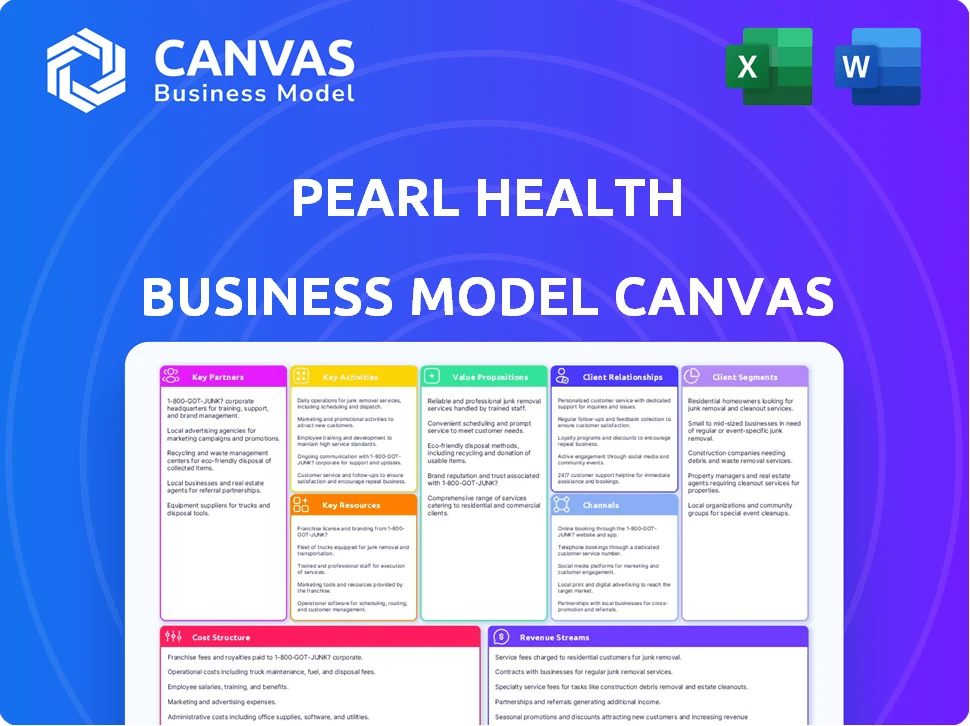
PEARL HEALTH BUSINESS MODEL CANVAS TEMPLATE RESEARCH
What is included in the product
 Detailed Word Document
Covers Pearl Health's customer segments, channels, and value propositions.

 Customizable Excel Spreadsheet
Condenses Pearl Health's strategy into a digestible format, enabling quick reviews.
Preview Before You Purchase
Business Model Canvas
This is the real deal! The preview you see is the exact Pearl Health Business Model Canvas document you'll receive. No hidden content or different formatting. Purchase, and download this same, ready-to-use file immediately.

Business Model Canvas Template

Pearl Health: Business Model Unveiled
Explore Pearl Health's strategy with our Business Model Canvas. Understand how they innovate in value propositions and customer segments. Discover their revenue streams, key activities, and crucial partnerships. Analyze their cost structure and channels for maximum impact. Uncover the competitive advantages shaping their success.
Partnerships

Healthcare Providers and Systems
Pearl Health's Key Partnerships heavily rely on collaboration with healthcare providers. They team up with primary care practices, physician networks, and health systems. These partnerships are vital for their value-based care approach. In 2024, value-based care spending reached $480 billion, highlighting its significance.
Technology and EHR Companies
Pearl Health relies heavily on partnerships with tech and EHR companies. These collaborations are vital for smooth platform integration into clinical workflows. In 2024, about 70% of healthcare providers used EHR systems. Data exchange enhancement is also a key goal.

Health Plans and Payers
Partnering with health plans, especially those in Medicare Advantage and value-based care models like ACO REACH, is crucial. This collaboration allows Pearl Health to align financial incentives, facilitating risk-sharing. In 2024, Medicare Advantage enrollment is projected to reach over 33 million. This partnership model is key to accessing patient data and managing care effectively.

Specialty Care Providers
Pearl Health strategically partners with specialty care providers, including cardiologists and endocrinologists, to enhance patient care and outcomes. These partnerships are crucial for coordinating care across various medical disciplines, ensuring a holistic approach. By integrating specialists into their network, Pearl Health aims to address the complex needs of patients more effectively. This collaborative model is designed to improve overall patient health and streamline healthcare delivery. In 2024, approximately 30% of U.S. healthcare spending was on specialty care.
- Partnerships with specialists expand the scope of care.
- Coordination across disciplines improves patient outcomes.
- Integration enhances the efficiency of healthcare delivery.
- Specialty care accounted for a significant portion of healthcare spending in 2024.
Data and Analytics Providers
Pearl Health's collaborations with data and analytics providers are vital. These partnerships furnish the platform with essential patient data and market intelligence. This helps Pearl Health identify areas for proactive care. For instance, partnerships with health data analytics firms can boost care effectiveness.
- In 2024, healthcare analytics spending is projected to reach $36.8 billion globally.
- Partnerships can enhance risk assessment.
- Data insights improve care coordination.
- Better data leads to more efficient resource allocation.
Strategic Alliances Fueling Healthcare Transformation
Key partnerships are essential for Pearl Health. Collaborations include specialists and data analytics firms. In 2024, specialist care made up roughly 30% of U.S. healthcare spending.
| Partnership Type | Purpose | 2024 Impact |
|---|---|---|
| Specialty Care | Improve outcomes | 30% US spending |
| Data Analytics | Patient insight | $36.8B market |
| Health Plans | Risk-sharing | 33M MA enrollees |
Activities

Platform Development and Maintenance
Pearl Health's core revolves around its platform. This includes consistent updates and maintenance. In 2024, they invested heavily in tech, with platform costs around $50M. They ensure user-friendliness and data-driven tools. Their tech supports provider success, aiming to boost value-based care adoption.
Data Analysis and Insight Generation
Pearl Health excels in data analysis, gathering crucial healthcare information to aid providers. They synthesize this data to pinpoint at-risk patients and pinpoint opportunities to enhance care. This data-driven approach can lead to significant cost reductions; for example, in 2024, value-based care models saved the U.S. healthcare system an estimated $50 billion. Insights generated help improve patient outcomes.

Provider Onboarding and Support
Pearl Health's core centers around integrating primary care providers. This involves a thorough onboarding process. Pearl Health offers training and support. This helps providers use their platform effectively. This is vital for the company's success.

Value-Based Care Program Management
Pearl Health's core involves managing value-based care programs, notably ACO REACH. They assist providers in navigating complexities like financial performance and regulatory compliance. This includes optimizing revenue within these models, which requires a deep understanding of healthcare economics. The goal is to enhance both patient outcomes and provider profitability.
- ACO REACH participation grew, with over 500,000 beneficiaries in 2024.
- Pearl Health's platform supports over 1,000 provider practices.
- Providers using Pearl Health saw a 10-15% increase in revenue.
- Regulatory compliance is maintained, with 98% of practices meeting standards.
Sales and Marketing
Sales and marketing are key for Pearl Health, driving expansion by attracting primary care practices and health systems. They must actively reach out to potential partners to grow their network and increase market presence. Effective strategies are crucial to secure new collaborations and boost service adoption. This involves showcasing their value proposition and building strong relationships.
- In 2024, healthcare marketing spend is projected to reach $3.2 billion.
- Digital marketing in healthcare is expected to grow to $2.6 billion by year-end 2024.
- Pearl Health's success hinges on effectively communicating its value proposition.
- Sales and marketing teams must focus on demonstrating cost savings and improved outcomes.
Boosting Healthcare: Tech, Data, and Value
Pearl Health's platform is vital, supporting providers. Its ongoing tech maintenance cost approximately $50M in 2024, aiming to boost value-based care.
Data analysis is critical, gathering info to help providers. Insights boost patient care, crucial to value-based care.
Pearl Health helps manage value-based care, notably ACO REACH. This includes helping providers with financial performance. It is an integral part of how they operate. ACO REACH participation included over 500,000 beneficiaries in 2024.
| Activity | Description | 2024 Data |
|---|---|---|
| Platform Development | Continuous tech updates, user-friendly design | Platform costs around $50M |
| Data Analysis | Healthcare data synthesis and insight | Saved the U.S. healthcare $50 billion |
| Value-Based Care Management | Manage ACO REACH programs | ACO REACH over 500,000 beneficiaries |
Resources

Technology Platform and Infrastructure
Pearl Health's technology platform is essential, housing data analytics, care coordination tools, and financial dashboards. The platform enables efficient data analysis, vital for value-based care. In 2024, investments in healthcare tech reached $28.1 billion, highlighting its importance. This technology supports Pearl Health's operations and strategic initiatives.
Data and Datasets
Pearl Health relies heavily on data. They need comprehensive healthcare data from many sources, including health plans and providers, to power their analytics.
This data is essential for generating insights, like predicting patient needs. Accurate data helps Pearl Health make better decisions.
In 2024, the healthcare analytics market was valued at around $39.3 billion. This shows how crucial data is for companies like Pearl Health.
Good data allows for improved patient care and helps manage costs. It's a core resource for their business model.
Their use of data reflects the industry's shift toward data-driven healthcare solutions.

Skilled Workforce
Pearl Health relies on a skilled workforce, including healthcare technology, value-based care, data science, and clinical practice experts. This team is crucial for innovation and delivering services. In 2024, the healthcare technology market was valued at over $200 billion, highlighting the importance of these skills. The demand for data scientists in healthcare increased by 28% in 2024.

Capital and Funding
Pearl Health's financial resources are crucial. Securing funding through investment rounds supports platform development and expansion. They need capital for operations, which includes paying healthcare providers and investing in technology. In 2024, healthcare technology companies raised billions in funding rounds. This funding enables Pearl Health to scale its operations and improve its services.
- Investment rounds provide capital for platform development.
- Funding supports expansion into new markets.
- Operational expenses are covered by secured funding.
- Healthcare technology companies raised billions in 2024.
Provider Network
Pearl Health's extensive provider network is a crucial resource, enabling its value-based care model. This network, consisting of primary care providers and health systems, is essential for patient engagement and care coordination. The platform's success hinges on the strength and reach of this network, which facilitates data sharing and collaborative care. The more providers using Pearl Health, the better the potential outcomes and financial benefits.
- As of 2024, Pearl Health partners with over 1,000 primary care practices.
- These practices collectively manage care for over 150,000 patients.
- Pearl Health's network spans 20 states, as of late 2024.
- The network's growth has been steady, with a 40% increase in provider partnerships in the last year.
Healthcare Innovation: Key Elements & Impact
Pearl Health leverages technology for data analytics, care coordination, and financial oversight. Access to comprehensive healthcare data is essential for their analytical capabilities; the healthcare analytics market hit approximately $39.3 billion in 2024.
A skilled workforce, including experts in healthcare technology and data science, is fundamental to their operational and strategic initiatives. Secured financial resources, such as investment rounds, fuel platform development and expansion; the healthcare technology sector saw billions in funding in 2024.
An extensive network of providers enables Pearl Health's value-based care model, driving patient engagement and care coordination. Partnering with primary care practices, with a 40% rise in partnerships in 2024, showcases the network's robust expansion and strategic importance.
| Resource | Description | 2024 Data/Impact |
|---|---|---|
| Technology Platform | Data analytics, care coordination, and financial dashboards. | Healthcare tech investments: $28.1B. |
| Data | Comprehensive healthcare data from health plans, providers. | Healthcare analytics market: ~$39.3B. |
| Workforce | Experts in healthcare tech, data science, value-based care. | Healthcare tech market >$200B. Data scientist demand up 28%. |
| Financial Resources | Investment rounds, operational funds. | Billions in funding for healthcare technology. |
| Provider Network | Primary care providers and health systems. | Over 1,000 practices, 150,000+ patients; 40% growth. |
Value Propositions

Enabling Success in Value-Based Care
Pearl Health's value proposition centers on empowering primary care providers to excel in value-based care, a shift from traditional fee-for-service models. They provide the essential tools, data analytics, and operational support needed for this transition.
This support includes insights into patient populations and risk stratification, crucial for managing care effectively. In 2024, value-based care models are increasingly prevalent, with the Centers for Medicare & Medicaid Services (CMS) pushing for wider adoption.
Pearl Health's platform facilitates improved patient outcomes and cost savings, aligning with the goals of value-based care. Data from 2024 shows a continued rise in healthcare providers adopting these models.
This approach allows providers to focus on patient well-being, while Pearl Health handles the complex data and administrative burdens. Successful value-based care can lead to higher financial rewards for providers.
By offering this comprehensive support, Pearl Health enables providers to succeed in a rapidly evolving healthcare landscape. Research in late 2024 shows a 15% increase in value-based care participation.
Improving Patient Outcomes
Pearl Health's value proposition centers on enhancing patient outcomes. They offer actionable insights, supporting proactive care tailored to patients with complex needs. This approach can lead to significant improvements; for example, data from 2024 shows that proactive care models reduce hospital readmission rates by up to 15%. This translates into better health and potentially lower healthcare costs.

Increasing Practice Revenue and Financial Performance
Pearl Health's platform optimizes practice finances in value-based care. This includes shared savings, leading to more stable revenue. Practices can improve financial performance by focusing on patient outcomes and data-driven decision-making. In 2024, practices using value-based care models saw revenue increases of up to 15%. This shift towards value can lead to a more predictable income stream for healthcare providers.

Reducing Administrative Burden
Pearl Health's value proposition includes reducing administrative burdens for healthcare providers. Their technology streamlines workflows, easing the administrative load linked to value-based care. This allows providers to concentrate on patient care, improving efficiency. This can lead to cost savings and better patient outcomes.
- Efficiency gains could reduce administrative costs by up to 20%.
- Providers using similar platforms report a 15% increase in time spent with patients.
- Reduced administrative tasks enhance provider satisfaction.
- Streamlined processes can improve claims processing by 25%.
Providing Actionable Data and Insights
Pearl Health offers providers actionable data, enabling informed decisions and prioritized patient care. This involves delivering clear, easy-to-understand insights on patient populations. In 2024, data analytics in healthcare saw a 15% increase in adoption, showing the importance of data-driven strategies. This helps providers focus on high-need patients effectively.
- Data-driven decisions: Improves care quality
- Focus on patients: Prioritizes those in need
- Adoption Increase: 15% increase in 2024
- Clear insights: Improves decision-making
Boosting Primary Care: Key Stats Revealed!
Pearl Health boosts primary care through value-based care, providing essential tools, data analysis, and operational assistance for healthcare providers. They focus on patient outcomes, offering data insights for proactive and tailored care, supported by cost savings. Pearl Health also streamlines administrative tasks, with tools to reduce provider burdens.
| Benefit | Impact | 2024 Data |
|---|---|---|
| Value-Based Care | Improved Financial Performance | Revenue Increased Up To 15% |
| Proactive Patient Care | Reduced Hospital Readmissions | Readmissions Drop Up to 15% |
| Administrative Efficiency | Cost Savings | Administrative Cost Reduction Up to 20% |
Product Information
Product Information
Shipping & Returns
Shipping & Returns
Description
What is included in the product
Detailed Word Document
Covers Pearl Health's customer segments, channels, and value propositions.
Customizable Excel Spreadsheet
Condenses Pearl Health's strategy into a digestible format, enabling quick reviews.
Preview Before You Purchase
Business Model Canvas
This is the real deal! The preview you see is the exact Pearl Health Business Model Canvas document you'll receive. No hidden content or different formatting. Purchase, and download this same, ready-to-use file immediately.
Business Model Canvas Template
Pearl Health: Business Model Unveiled
Explore Pearl Health's strategy with our Business Model Canvas. Understand how they innovate in value propositions and customer segments. Discover their revenue streams, key activities, and crucial partnerships. Analyze their cost structure and channels for maximum impact. Uncover the competitive advantages shaping their success.
Partnerships
Healthcare Providers and Systems
Pearl Health's Key Partnerships heavily rely on collaboration with healthcare providers. They team up with primary care practices, physician networks, and health systems. These partnerships are vital for their value-based care approach. In 2024, value-based care spending reached $480 billion, highlighting its significance.
Technology and EHR Companies
Pearl Health relies heavily on partnerships with tech and EHR companies. These collaborations are vital for smooth platform integration into clinical workflows. In 2024, about 70% of healthcare providers used EHR systems. Data exchange enhancement is also a key goal.
Health Plans and Payers
Partnering with health plans, especially those in Medicare Advantage and value-based care models like ACO REACH, is crucial. This collaboration allows Pearl Health to align financial incentives, facilitating risk-sharing. In 2024, Medicare Advantage enrollment is projected to reach over 33 million. This partnership model is key to accessing patient data and managing care effectively.
Specialty Care Providers
Pearl Health strategically partners with specialty care providers, including cardiologists and endocrinologists, to enhance patient care and outcomes. These partnerships are crucial for coordinating care across various medical disciplines, ensuring a holistic approach. By integrating specialists into their network, Pearl Health aims to address the complex needs of patients more effectively. This collaborative model is designed to improve overall patient health and streamline healthcare delivery. In 2024, approximately 30% of U.S. healthcare spending was on specialty care.
- Partnerships with specialists expand the scope of care.
- Coordination across disciplines improves patient outcomes.
- Integration enhances the efficiency of healthcare delivery.
- Specialty care accounted for a significant portion of healthcare spending in 2024.
Data and Analytics Providers
Pearl Health's collaborations with data and analytics providers are vital. These partnerships furnish the platform with essential patient data and market intelligence. This helps Pearl Health identify areas for proactive care. For instance, partnerships with health data analytics firms can boost care effectiveness.
- In 2024, healthcare analytics spending is projected to reach $36.8 billion globally.
- Partnerships can enhance risk assessment.
- Data insights improve care coordination.
- Better data leads to more efficient resource allocation.
Strategic Alliances Fueling Healthcare Transformation
Key partnerships are essential for Pearl Health. Collaborations include specialists and data analytics firms. In 2024, specialist care made up roughly 30% of U.S. healthcare spending.
| Partnership Type | Purpose | 2024 Impact |
|---|---|---|
| Specialty Care | Improve outcomes | 30% US spending |
| Data Analytics | Patient insight | $36.8B market |
| Health Plans | Risk-sharing | 33M MA enrollees |
Activities
Platform Development and Maintenance
Pearl Health's core revolves around its platform. This includes consistent updates and maintenance. In 2024, they invested heavily in tech, with platform costs around $50M. They ensure user-friendliness and data-driven tools. Their tech supports provider success, aiming to boost value-based care adoption.
Data Analysis and Insight Generation
Pearl Health excels in data analysis, gathering crucial healthcare information to aid providers. They synthesize this data to pinpoint at-risk patients and pinpoint opportunities to enhance care. This data-driven approach can lead to significant cost reductions; for example, in 2024, value-based care models saved the U.S. healthcare system an estimated $50 billion. Insights generated help improve patient outcomes.
Provider Onboarding and Support
Pearl Health's core centers around integrating primary care providers. This involves a thorough onboarding process. Pearl Health offers training and support. This helps providers use their platform effectively. This is vital for the company's success.
Value-Based Care Program Management
Pearl Health's core involves managing value-based care programs, notably ACO REACH. They assist providers in navigating complexities like financial performance and regulatory compliance. This includes optimizing revenue within these models, which requires a deep understanding of healthcare economics. The goal is to enhance both patient outcomes and provider profitability.
- ACO REACH participation grew, with over 500,000 beneficiaries in 2024.
- Pearl Health's platform supports over 1,000 provider practices.
- Providers using Pearl Health saw a 10-15% increase in revenue.
- Regulatory compliance is maintained, with 98% of practices meeting standards.
Sales and Marketing
Sales and marketing are key for Pearl Health, driving expansion by attracting primary care practices and health systems. They must actively reach out to potential partners to grow their network and increase market presence. Effective strategies are crucial to secure new collaborations and boost service adoption. This involves showcasing their value proposition and building strong relationships.
- In 2024, healthcare marketing spend is projected to reach $3.2 billion.
- Digital marketing in healthcare is expected to grow to $2.6 billion by year-end 2024.
- Pearl Health's success hinges on effectively communicating its value proposition.
- Sales and marketing teams must focus on demonstrating cost savings and improved outcomes.
Boosting Healthcare: Tech, Data, and Value
Pearl Health's platform is vital, supporting providers. Its ongoing tech maintenance cost approximately $50M in 2024, aiming to boost value-based care.
Data analysis is critical, gathering info to help providers. Insights boost patient care, crucial to value-based care.
Pearl Health helps manage value-based care, notably ACO REACH. This includes helping providers with financial performance. It is an integral part of how they operate. ACO REACH participation included over 500,000 beneficiaries in 2024.
| Activity | Description | 2024 Data |
|---|---|---|
| Platform Development | Continuous tech updates, user-friendly design | Platform costs around $50M |
| Data Analysis | Healthcare data synthesis and insight | Saved the U.S. healthcare $50 billion |
| Value-Based Care Management | Manage ACO REACH programs | ACO REACH over 500,000 beneficiaries |
Resources
Technology Platform and Infrastructure
Pearl Health's technology platform is essential, housing data analytics, care coordination tools, and financial dashboards. The platform enables efficient data analysis, vital for value-based care. In 2024, investments in healthcare tech reached $28.1 billion, highlighting its importance. This technology supports Pearl Health's operations and strategic initiatives.
Data and Datasets
Pearl Health relies heavily on data. They need comprehensive healthcare data from many sources, including health plans and providers, to power their analytics.
This data is essential for generating insights, like predicting patient needs. Accurate data helps Pearl Health make better decisions.
In 2024, the healthcare analytics market was valued at around $39.3 billion. This shows how crucial data is for companies like Pearl Health.
Good data allows for improved patient care and helps manage costs. It's a core resource for their business model.
Their use of data reflects the industry's shift toward data-driven healthcare solutions.
Skilled Workforce
Pearl Health relies on a skilled workforce, including healthcare technology, value-based care, data science, and clinical practice experts. This team is crucial for innovation and delivering services. In 2024, the healthcare technology market was valued at over $200 billion, highlighting the importance of these skills. The demand for data scientists in healthcare increased by 28% in 2024.
Capital and Funding
Pearl Health's financial resources are crucial. Securing funding through investment rounds supports platform development and expansion. They need capital for operations, which includes paying healthcare providers and investing in technology. In 2024, healthcare technology companies raised billions in funding rounds. This funding enables Pearl Health to scale its operations and improve its services.
- Investment rounds provide capital for platform development.
- Funding supports expansion into new markets.
- Operational expenses are covered by secured funding.
- Healthcare technology companies raised billions in 2024.
Provider Network
Pearl Health's extensive provider network is a crucial resource, enabling its value-based care model. This network, consisting of primary care providers and health systems, is essential for patient engagement and care coordination. The platform's success hinges on the strength and reach of this network, which facilitates data sharing and collaborative care. The more providers using Pearl Health, the better the potential outcomes and financial benefits.
- As of 2024, Pearl Health partners with over 1,000 primary care practices.
- These practices collectively manage care for over 150,000 patients.
- Pearl Health's network spans 20 states, as of late 2024.
- The network's growth has been steady, with a 40% increase in provider partnerships in the last year.
Healthcare Innovation: Key Elements & Impact
Pearl Health leverages technology for data analytics, care coordination, and financial oversight. Access to comprehensive healthcare data is essential for their analytical capabilities; the healthcare analytics market hit approximately $39.3 billion in 2024.
A skilled workforce, including experts in healthcare technology and data science, is fundamental to their operational and strategic initiatives. Secured financial resources, such as investment rounds, fuel platform development and expansion; the healthcare technology sector saw billions in funding in 2024.
An extensive network of providers enables Pearl Health's value-based care model, driving patient engagement and care coordination. Partnering with primary care practices, with a 40% rise in partnerships in 2024, showcases the network's robust expansion and strategic importance.
| Resource | Description | 2024 Data/Impact |
|---|---|---|
| Technology Platform | Data analytics, care coordination, and financial dashboards. | Healthcare tech investments: $28.1B. |
| Data | Comprehensive healthcare data from health plans, providers. | Healthcare analytics market: ~$39.3B. |
| Workforce | Experts in healthcare tech, data science, value-based care. | Healthcare tech market >$200B. Data scientist demand up 28%. |
| Financial Resources | Investment rounds, operational funds. | Billions in funding for healthcare technology. |
| Provider Network | Primary care providers and health systems. | Over 1,000 practices, 150,000+ patients; 40% growth. |
Value Propositions
Enabling Success in Value-Based Care
Pearl Health's value proposition centers on empowering primary care providers to excel in value-based care, a shift from traditional fee-for-service models. They provide the essential tools, data analytics, and operational support needed for this transition.
This support includes insights into patient populations and risk stratification, crucial for managing care effectively. In 2024, value-based care models are increasingly prevalent, with the Centers for Medicare & Medicaid Services (CMS) pushing for wider adoption.
Pearl Health's platform facilitates improved patient outcomes and cost savings, aligning with the goals of value-based care. Data from 2024 shows a continued rise in healthcare providers adopting these models.
This approach allows providers to focus on patient well-being, while Pearl Health handles the complex data and administrative burdens. Successful value-based care can lead to higher financial rewards for providers.
By offering this comprehensive support, Pearl Health enables providers to succeed in a rapidly evolving healthcare landscape. Research in late 2024 shows a 15% increase in value-based care participation.
Improving Patient Outcomes
Pearl Health's value proposition centers on enhancing patient outcomes. They offer actionable insights, supporting proactive care tailored to patients with complex needs. This approach can lead to significant improvements; for example, data from 2024 shows that proactive care models reduce hospital readmission rates by up to 15%. This translates into better health and potentially lower healthcare costs.
Increasing Practice Revenue and Financial Performance
Pearl Health's platform optimizes practice finances in value-based care. This includes shared savings, leading to more stable revenue. Practices can improve financial performance by focusing on patient outcomes and data-driven decision-making. In 2024, practices using value-based care models saw revenue increases of up to 15%. This shift towards value can lead to a more predictable income stream for healthcare providers.
Reducing Administrative Burden
Pearl Health's value proposition includes reducing administrative burdens for healthcare providers. Their technology streamlines workflows, easing the administrative load linked to value-based care. This allows providers to concentrate on patient care, improving efficiency. This can lead to cost savings and better patient outcomes.
- Efficiency gains could reduce administrative costs by up to 20%.
- Providers using similar platforms report a 15% increase in time spent with patients.
- Reduced administrative tasks enhance provider satisfaction.
- Streamlined processes can improve claims processing by 25%.
Providing Actionable Data and Insights
Pearl Health offers providers actionable data, enabling informed decisions and prioritized patient care. This involves delivering clear, easy-to-understand insights on patient populations. In 2024, data analytics in healthcare saw a 15% increase in adoption, showing the importance of data-driven strategies. This helps providers focus on high-need patients effectively.
- Data-driven decisions: Improves care quality
- Focus on patients: Prioritizes those in need
- Adoption Increase: 15% increase in 2024
- Clear insights: Improves decision-making
Boosting Primary Care: Key Stats Revealed!
Pearl Health boosts primary care through value-based care, providing essential tools, data analysis, and operational assistance for healthcare providers. They focus on patient outcomes, offering data insights for proactive and tailored care, supported by cost savings. Pearl Health also streamlines administrative tasks, with tools to reduce provider burdens.
| Benefit | Impact | 2024 Data |
|---|---|---|
| Value-Based Care | Improved Financial Performance | Revenue Increased Up To 15% |
| Proactive Patient Care | Reduced Hospital Readmissions | Readmissions Drop Up to 15% |
| Administrative Efficiency | Cost Savings | Administrative Cost Reduction Up to 20% |