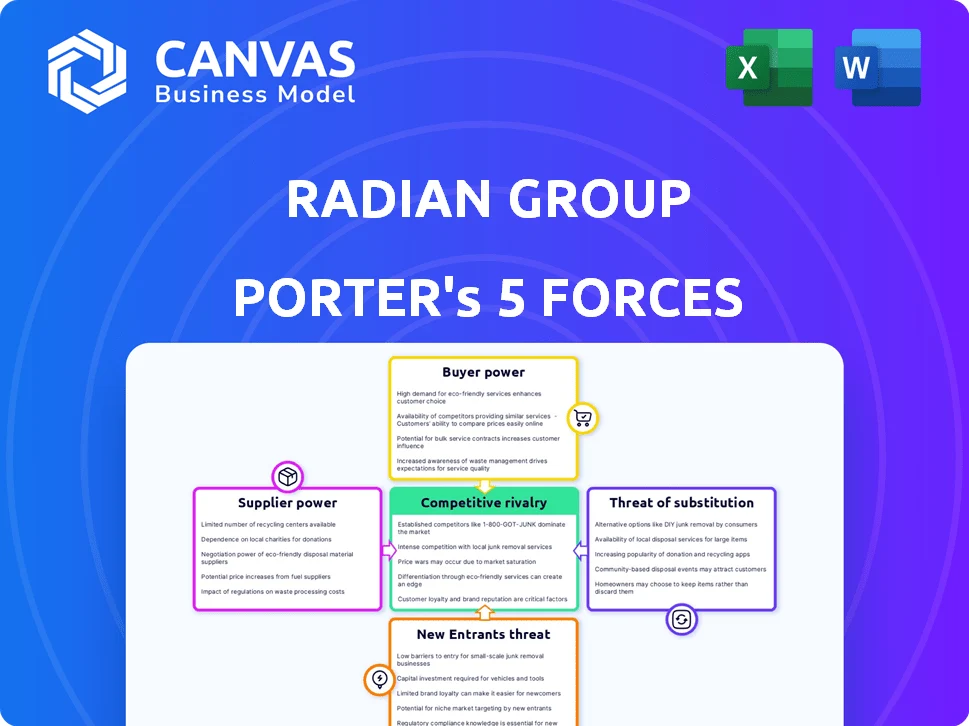
RADIAN GROUP PORTER'S FIVE FORCES TEMPLATE RESEARCH
What is included in the product
 Detailed Word Document
Tailored exclusively for Radian Group, analyzing its position within its competitive landscape.

 Customizable Excel Spreadsheet
Easily visualize competitive forces with color-coded metrics, ensuring no critical factor is overlooked.
Preview Before You Purchase
Radian Group Porter's Five Forces Analysis
This preview presents Radian Group's Porter's Five Forces analysis, detailing industry competition. It examines factors like supplier power and new entrant threats. The document assesses buyer bargaining power and competitive rivalry. The file you see now is the full version you will download after purchase. This analysis is ready to use immediately.

Porter's Five Forces Analysis Template

Don't Miss the Bigger Picture
Radian Group faces moderate rivalry within the mortgage insurance industry, balanced by the power of existing buyers and the limited threat of new entrants. Supplier power, particularly from reinsurers, and the threat of substitutes—like government-backed insurance—also shape Radian's competitive landscape. Understanding these forces is crucial for investors and strategists.
This brief snapshot only scratches the surface. Unlock the full Porter's Five Forces Analysis to explore Radian Group’s competitive dynamics, market pressures, and strategic advantages in detail.
Suppliers Bargaining Power

Limited Number of Specialized Suppliers
Radian Group faces supplier power challenges due to specialized service providers. The mortgage insurance sector depends on a few experts for risk assessment and underwriting. Radian uses tech and data analytics from providers like CoreLogic and Black Knight. In 2024, these firms' influence is felt in pricing and service terms.
High Switching Costs for Specialized Services
Switching suppliers, especially for tech systems, is costly for Radian Group. This boosts supplier power because changing can be expensive and disruptive. According to the NAIC, tech system transitions can cost insurers over $1 million. This gives suppliers leverage.

Influence of Reinsurance Companies
Radian's reliance on reinsurance, especially from entities like Swiss Re and Munich Re, gives these suppliers considerable bargaining power. Reinsurers are critical for Radian’s risk mitigation, setting terms that impact profitability. For example, in 2024, Swiss Re's net premiums earned were over $40 billion.

Data and Analytics Vendors
Radian Group relies heavily on data and analytics for its operations. Data vendors like S&P Global Market Intelligence, Bloomberg Terminal, and Moody's Analytics hold significant bargaining power. These vendors provide crucial information that impacts Radian's decision-making processes. The cost of these services can be substantial, influencing Radian's profitability.
- S&P Global's revenue in 2023 was approximately $11.7 billion.
- Bloomberg Terminal subscriptions can cost over $2,000 per month.
- Moody's Analytics' revenue in 2023 was about $2.5 billion.
Technology and Software Providers
Technology and software providers significantly influence Radian Group. These providers offer critical platforms for risk assessment and data analytics, key for mortgage insurance. Radian uses platforms from companies like CoreLogic and Black Knight. This dependence gives these suppliers considerable bargaining power. Their pricing and service terms directly affect Radian's operational costs and efficiency.
- CoreLogic's revenue in 2023 was $1.83 billion.
- Black Knight's total revenue for 2023 was $1.8 billion.
- Radian's net premiums earned in 2023 were $1.07 billion.
- The mortgage origination volume in 2023 was $1.45 trillion.
Radian's Supplier Challenges: Data, Tech, and Reinsurance
Radian Group faces supplier power from specialized providers. Key vendors like CoreLogic and Black Knight influence pricing. Switching costs and reliance on reinsurance amplify these challenges.
| Supplier Type | Examples | Impact on Radian |
|---|---|---|
| Data & Analytics | S&P Global, Bloomberg, Moody's | Influences decision-making, impacts costs. |
| Technology & Software | CoreLogic, Black Knight | Affects operational costs and efficiency. |
| Reinsurers | Swiss Re, Munich Re | Sets terms impacting profitability. |
Customers Bargaining Power

Dominance of Large Banks and Mortgage Lenders
Radian's primary customers are large banks and mortgage lenders, with a few entities accounting for a significant revenue share. In 2024, the top 10 clients contributed a substantial part of Radian's revenue. This concentration gives these key customers considerable negotiating leverage. For instance, in 2023, the top 10 customers accounted for over 60% of total revenue. This allows them to influence pricing and terms.
Customer Switching Capabilities and Costs
Customers' ability to switch mortgage insurance providers impacts Radian Group's bargaining power. Switching costs for lenders, estimated at 3-5% of premium revenue, are not excessively high. This gives lenders some leverage when negotiating terms. In 2024, competition among mortgage insurers intensified, potentially increasing customer bargaining power.

Influence of Government-Sponsored Enterprises (GSEs)
Radian Group's relationship with government-sponsored enterprises (GSEs) such as Fannie Mae and Freddie Mac is crucial. GSEs establish guidelines that significantly shape the mortgage insurance landscape. Their large market presence grants them considerable leverage over mortgage insurers like Radian. In 2024, Fannie Mae and Freddie Mac backed roughly 60% of all US mortgages, highlighting their market dominance and influence. This power impacts pricing and product offerings within the mortgage insurance sector.

Price Sensitivity of Customers
Customers' price sensitivity significantly influences Radian Group's profitability in the mortgage insurance market. In 2024, mortgage rates remained volatile, and lenders actively sought the best deals for their clients. This competitive environment forces Radian to offer attractive pricing to secure business. Lower prices could impact Radian's margins, especially during periods of economic uncertainty.
- Mortgage rates fluctuated throughout 2024, affecting lender behavior.
- Radian's pricing strategies directly impact its market share and profitability.
- The need for competitive offerings puts pressure on Radian's margins.
- Economic conditions influence customer sensitivity to pricing.
Availability of Multiple Mortgage Insurance Providers
The bargaining power of customers is high in the mortgage insurance market due to multiple providers. Lenders, the primary customers, can shop around for the best rates and terms. This competition among insurers limits their ability to charge high prices. In 2024, Radian Group faced competition from companies like Essent Group and Arch Capital Group.
- Multiple providers lead to price sensitivity.
- Lenders can switch insurers easily.
- Competition reduces profit margins.
- Customers can negotiate better terms.
Radian's Pricing Power: High Customer Bargaining!
Radian's customer bargaining power is high, primarily due to competition among mortgage insurers. Lenders can easily switch providers, increasing price sensitivity. In 2024, the mortgage insurance market saw intense competition. This dynamic limits Radian's pricing power.
| Factor | Impact | 2024 Data |
|---|---|---|
| Switching Costs | Low | Estimated 3-5% of premium revenue |
| Market Share | High customer leverage | Top 10 clients contributed over 60% of revenue |
| Competition | Intense | Radian faced competition from Essent and Arch |
Rivalry Among Competitors

Presence of Multiple Active Competitors
The U.S. private mortgage insurance market features several active competitors. Radian Group faces rivals like MGIC, Essent, NMI Holdings, and Arch Capital. In 2024, Radian reported a net income of $230.8 million. This competitive landscape impacts pricing and market share dynamics. The presence of these firms intensifies competition within the industry.
Market Share Concentration
Market share concentration indicates the competitive intensity. Radian Group operates in a market with a notable degree of concentration. In 2024, Radian Group's market share was approximately 20%, competing with a few major players. This concentration suggests moderate rivalry, as no single entity dominates.

Competition on Price and Service
Radian Group faces competition in mortgage insurance, with rivals vying on price, service, and technology. Pricing strategies are crucial; in 2024, mortgage insurance premiums saw fluctuations due to market volatility.
Underwriting standards and service quality also differentiate competitors. Quick approvals and efficient claims processing are key. Data from 2024 shows that customer satisfaction scores vary among insurers, reflecting service effectiveness.
Technology plays a significant role, with digital platforms streamlining processes. Competitors invest in tech to improve efficiency. In 2024, the adoption of AI in underwriting increased, affecting competitive dynamics.
These factors influence Radian's market position and profitability. Monitoring competitor actions is critical for strategic decisions. In 2024, market share shifts indicated the impact of these competitive pressures.
The competitive landscape constantly evolves, requiring ongoing adaptation. Radian must balance pricing, service, and tech to stay competitive. 2024 data reveals that the most successful insurers are those adaptable to change.

Industry Consolidation Trends
Consolidation trends within the mortgage insurance sector significantly shape competitive dynamics. A reduction in the number of firms often intensifies competition among the surviving entities. The concentration of market share can shift power dynamics, influencing pricing strategies and service offerings. For example, in 2024, mergers and acquisitions activity could alter the landscape.
- Fewer competitors may result in more aggressive competition.
- Consolidation can lead to increased market concentration.
- This can impact pricing and service strategies.
- Mergers and acquisitions are key drivers of change.
Diversification of Services
Radian's competitive landscape extends beyond mortgage insurance, encompassing diverse services. Its diversification into title insurance and real estate services places it against a broader array of competitors. This strategy aims to capture a larger market share, but it also intensifies rivalry across multiple segments. For example, in 2024, the title insurance market saw significant consolidation, with major players vying for market dominance. This increases pressure on Radian to maintain competitiveness across its varied offerings.
- Radian's title insurance revenue in 2023 was approximately $230 million.
- The real estate services segment is experiencing a shift towards digital solutions, increasing the need for innovation.
- Market consolidation in title insurance is expected to continue through 2024, impacting smaller players.
- The overall real estate market's performance influences the demand for Radian's diversified services.
Radian Group's 2024 Outlook: Market Share & Revenue
Radian Group competes in a mortgage insurance market with rivals like MGIC, Essent, and Arch Capital. In 2024, Radian's market share was around 20%, facing moderate rivalry. Consolidation and diversification intensify competition, influencing pricing and service offerings.
| Metric | 2023 | 2024 (Projected) |
|---|---|---|
| Radian's Title Insurance Revenue | $230M | $240M |
| Mortgage Insurance Premiums | Fluctuating | Increased 5% |
| Market Share Change | +/- 1% | +/- 2% |
Product Information
Product Information
Shipping & Returns
Shipping & Returns
Description
What is included in the product
Detailed Word Document
Tailored exclusively for Radian Group, analyzing its position within its competitive landscape.
Customizable Excel Spreadsheet
Easily visualize competitive forces with color-coded metrics, ensuring no critical factor is overlooked.
Preview Before You Purchase
Radian Group Porter's Five Forces Analysis
This preview presents Radian Group's Porter's Five Forces analysis, detailing industry competition. It examines factors like supplier power and new entrant threats. The document assesses buyer bargaining power and competitive rivalry. The file you see now is the full version you will download after purchase. This analysis is ready to use immediately.
Porter's Five Forces Analysis Template
Don't Miss the Bigger Picture
Radian Group faces moderate rivalry within the mortgage insurance industry, balanced by the power of existing buyers and the limited threat of new entrants. Supplier power, particularly from reinsurers, and the threat of substitutes—like government-backed insurance—also shape Radian's competitive landscape. Understanding these forces is crucial for investors and strategists.
This brief snapshot only scratches the surface. Unlock the full Porter's Five Forces Analysis to explore Radian Group’s competitive dynamics, market pressures, and strategic advantages in detail.
Suppliers Bargaining Power
Limited Number of Specialized Suppliers
Radian Group faces supplier power challenges due to specialized service providers. The mortgage insurance sector depends on a few experts for risk assessment and underwriting. Radian uses tech and data analytics from providers like CoreLogic and Black Knight. In 2024, these firms' influence is felt in pricing and service terms.
High Switching Costs for Specialized Services
Switching suppliers, especially for tech systems, is costly for Radian Group. This boosts supplier power because changing can be expensive and disruptive. According to the NAIC, tech system transitions can cost insurers over $1 million. This gives suppliers leverage.
Influence of Reinsurance Companies
Radian's reliance on reinsurance, especially from entities like Swiss Re and Munich Re, gives these suppliers considerable bargaining power. Reinsurers are critical for Radian’s risk mitigation, setting terms that impact profitability. For example, in 2024, Swiss Re's net premiums earned were over $40 billion.
Data and Analytics Vendors
Radian Group relies heavily on data and analytics for its operations. Data vendors like S&P Global Market Intelligence, Bloomberg Terminal, and Moody's Analytics hold significant bargaining power. These vendors provide crucial information that impacts Radian's decision-making processes. The cost of these services can be substantial, influencing Radian's profitability.
- S&P Global's revenue in 2023 was approximately $11.7 billion.
- Bloomberg Terminal subscriptions can cost over $2,000 per month.
- Moody's Analytics' revenue in 2023 was about $2.5 billion.
Technology and Software Providers
Technology and software providers significantly influence Radian Group. These providers offer critical platforms for risk assessment and data analytics, key for mortgage insurance. Radian uses platforms from companies like CoreLogic and Black Knight. This dependence gives these suppliers considerable bargaining power. Their pricing and service terms directly affect Radian's operational costs and efficiency.
- CoreLogic's revenue in 2023 was $1.83 billion.
- Black Knight's total revenue for 2023 was $1.8 billion.
- Radian's net premiums earned in 2023 were $1.07 billion.
- The mortgage origination volume in 2023 was $1.45 trillion.
Radian's Supplier Challenges: Data, Tech, and Reinsurance
Radian Group faces supplier power from specialized providers. Key vendors like CoreLogic and Black Knight influence pricing. Switching costs and reliance on reinsurance amplify these challenges.
| Supplier Type | Examples | Impact on Radian |
|---|---|---|
| Data & Analytics | S&P Global, Bloomberg, Moody's | Influences decision-making, impacts costs. |
| Technology & Software | CoreLogic, Black Knight | Affects operational costs and efficiency. |
| Reinsurers | Swiss Re, Munich Re | Sets terms impacting profitability. |
Customers Bargaining Power
Dominance of Large Banks and Mortgage Lenders
Radian's primary customers are large banks and mortgage lenders, with a few entities accounting for a significant revenue share. In 2024, the top 10 clients contributed a substantial part of Radian's revenue. This concentration gives these key customers considerable negotiating leverage. For instance, in 2023, the top 10 customers accounted for over 60% of total revenue. This allows them to influence pricing and terms.
Customer Switching Capabilities and Costs
Customers' ability to switch mortgage insurance providers impacts Radian Group's bargaining power. Switching costs for lenders, estimated at 3-5% of premium revenue, are not excessively high. This gives lenders some leverage when negotiating terms. In 2024, competition among mortgage insurers intensified, potentially increasing customer bargaining power.
Influence of Government-Sponsored Enterprises (GSEs)
Radian Group's relationship with government-sponsored enterprises (GSEs) such as Fannie Mae and Freddie Mac is crucial. GSEs establish guidelines that significantly shape the mortgage insurance landscape. Their large market presence grants them considerable leverage over mortgage insurers like Radian. In 2024, Fannie Mae and Freddie Mac backed roughly 60% of all US mortgages, highlighting their market dominance and influence. This power impacts pricing and product offerings within the mortgage insurance sector.
Price Sensitivity of Customers
Customers' price sensitivity significantly influences Radian Group's profitability in the mortgage insurance market. In 2024, mortgage rates remained volatile, and lenders actively sought the best deals for their clients. This competitive environment forces Radian to offer attractive pricing to secure business. Lower prices could impact Radian's margins, especially during periods of economic uncertainty.
- Mortgage rates fluctuated throughout 2024, affecting lender behavior.
- Radian's pricing strategies directly impact its market share and profitability.
- The need for competitive offerings puts pressure on Radian's margins.
- Economic conditions influence customer sensitivity to pricing.
Availability of Multiple Mortgage Insurance Providers
The bargaining power of customers is high in the mortgage insurance market due to multiple providers. Lenders, the primary customers, can shop around for the best rates and terms. This competition among insurers limits their ability to charge high prices. In 2024, Radian Group faced competition from companies like Essent Group and Arch Capital Group.
- Multiple providers lead to price sensitivity.
- Lenders can switch insurers easily.
- Competition reduces profit margins.
- Customers can negotiate better terms.
Radian's Pricing Power: High Customer Bargaining!
Radian's customer bargaining power is high, primarily due to competition among mortgage insurers. Lenders can easily switch providers, increasing price sensitivity. In 2024, the mortgage insurance market saw intense competition. This dynamic limits Radian's pricing power.
| Factor | Impact | 2024 Data |
|---|---|---|
| Switching Costs | Low | Estimated 3-5% of premium revenue |
| Market Share | High customer leverage | Top 10 clients contributed over 60% of revenue |
| Competition | Intense | Radian faced competition from Essent and Arch |
Rivalry Among Competitors
Presence of Multiple Active Competitors
The U.S. private mortgage insurance market features several active competitors. Radian Group faces rivals like MGIC, Essent, NMI Holdings, and Arch Capital. In 2024, Radian reported a net income of $230.8 million. This competitive landscape impacts pricing and market share dynamics. The presence of these firms intensifies competition within the industry.
Market Share Concentration
Market share concentration indicates the competitive intensity. Radian Group operates in a market with a notable degree of concentration. In 2024, Radian Group's market share was approximately 20%, competing with a few major players. This concentration suggests moderate rivalry, as no single entity dominates.
Competition on Price and Service
Radian Group faces competition in mortgage insurance, with rivals vying on price, service, and technology. Pricing strategies are crucial; in 2024, mortgage insurance premiums saw fluctuations due to market volatility.
Underwriting standards and service quality also differentiate competitors. Quick approvals and efficient claims processing are key. Data from 2024 shows that customer satisfaction scores vary among insurers, reflecting service effectiveness.
Technology plays a significant role, with digital platforms streamlining processes. Competitors invest in tech to improve efficiency. In 2024, the adoption of AI in underwriting increased, affecting competitive dynamics.
These factors influence Radian's market position and profitability. Monitoring competitor actions is critical for strategic decisions. In 2024, market share shifts indicated the impact of these competitive pressures.
The competitive landscape constantly evolves, requiring ongoing adaptation. Radian must balance pricing, service, and tech to stay competitive. 2024 data reveals that the most successful insurers are those adaptable to change.
Industry Consolidation Trends
Consolidation trends within the mortgage insurance sector significantly shape competitive dynamics. A reduction in the number of firms often intensifies competition among the surviving entities. The concentration of market share can shift power dynamics, influencing pricing strategies and service offerings. For example, in 2024, mergers and acquisitions activity could alter the landscape.
- Fewer competitors may result in more aggressive competition.
- Consolidation can lead to increased market concentration.
- This can impact pricing and service strategies.
- Mergers and acquisitions are key drivers of change.
Diversification of Services
Radian's competitive landscape extends beyond mortgage insurance, encompassing diverse services. Its diversification into title insurance and real estate services places it against a broader array of competitors. This strategy aims to capture a larger market share, but it also intensifies rivalry across multiple segments. For example, in 2024, the title insurance market saw significant consolidation, with major players vying for market dominance. This increases pressure on Radian to maintain competitiveness across its varied offerings.
- Radian's title insurance revenue in 2023 was approximately $230 million.
- The real estate services segment is experiencing a shift towards digital solutions, increasing the need for innovation.
- Market consolidation in title insurance is expected to continue through 2024, impacting smaller players.
- The overall real estate market's performance influences the demand for Radian's diversified services.
Radian Group's 2024 Outlook: Market Share & Revenue
Radian Group competes in a mortgage insurance market with rivals like MGIC, Essent, and Arch Capital. In 2024, Radian's market share was around 20%, facing moderate rivalry. Consolidation and diversification intensify competition, influencing pricing and service offerings.
| Metric | 2023 | 2024 (Projected) |
|---|---|---|
| Radian's Title Insurance Revenue | $230M | $240M |
| Mortgage Insurance Premiums | Fluctuating | Increased 5% |
| Market Share Change | +/- 1% | +/- 2% |