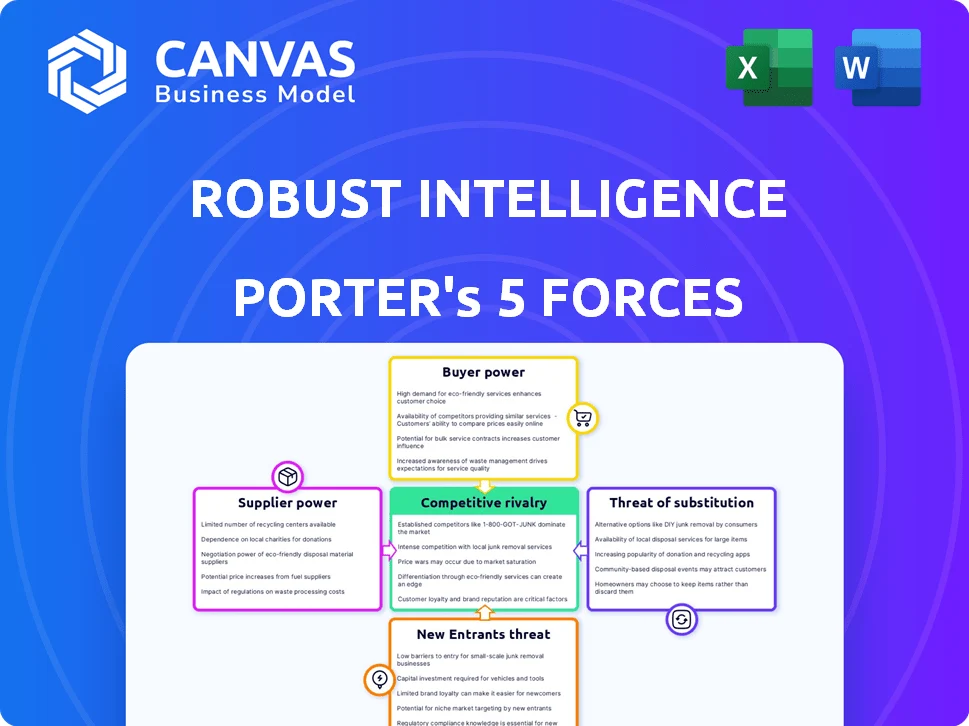
ROBUST INTELLIGENCE PORTER'S FIVE FORCES TEMPLATE RESEARCH
What is included in the product
 Detailed Word Document
Tailored exclusively for Robust Intelligence, analyzing its position within its competitive landscape.

 Customizable Excel Spreadsheet
A flexible system to adjust for different markets or scenarios.
Full Version Awaits
Robust Intelligence Porter's Five Forces Analysis
This preview reveals the complete Porter's Five Forces analysis for Robust Intelligence. This in-depth analysis is ready for immediate download after purchase.

Porter's Five Forces Analysis Template

From Overview to Strategy Blueprint
Robust Intelligence faces a dynamic competitive landscape. Analyzing its market through Porter's Five Forces reveals complex pressures. We see moderate rivalry and growing supplier influence. Buyer power is significant, with substitution threats present. This preliminary view hints at crucial strategic considerations.
The complete report reveals the real forces shaping Robust Intelligence’s industry—from supplier influence to threat of new entrants. Gain actionable insights to drive smarter decision-making.
Suppliers Bargaining Power

Availability of AI Security Expertise
The AI security landscape demands specialized skills, creating a talent scarcity. This limited pool of experts elevates their bargaining power. In 2024, the average cybersecurity analyst salary was around $102,600, reflecting high demand. Robust Intelligence, like others, faces rising labor costs due to this dynamic.
Reliance on Cloud Infrastructure Providers
Robust Intelligence, as a tech firm, probably uses cloud providers for its infrastructure. Cloud providers hold considerable bargaining power due to their market dominance. In 2024, the top three cloud providers controlled about 65% of the global market. This can lead to increased operational costs for Robust Intelligence, influenced by pricing strategies.

Availability of High-Quality Training Data
Robust Intelligence's success heavily depends on accessing top-tier training data, even though data providers aren't suppliers in the usual way. The quality and cost of data directly impact the resources needed for AI security model development. High-quality, diverse datasets are essential for creating effective AI models. In 2024, the market for high-quality training data is projected to be valued at $1.2 billion.

Proprietary Technology and Algorithms
Robust Intelligence's platform leverages proprietary technology, including algorithmic red teaming and threat intelligence pipelines. This internal capability significantly reduces the company's reliance on external suppliers for crucial technology components, thereby diminishing the suppliers' bargaining power. For example, in 2024, companies with strong in-house tech capabilities saw a 15% decrease in costs related to external tech services. This strategic move allows Robust Intelligence to maintain greater control over its technology stack and associated costs.
- Internal tech reduces reliance on external suppliers.
- Strong in-house tech can decrease external service costs.
- Robust Intelligence maintains control over tech.
Open-Source Contributions and Standards
Robust Intelligence actively engages with organizations like MITRE, NIST, and OWASP, which are crucial in setting AI security standards. This involvement allows the company to influence the evolution of AI security best practices. By participating in open-source projects, Robust Intelligence can shape the availability and advancement of underlying technologies. This strategic approach impacts the power dynamics of suppliers, particularly those providing key AI components.
- MITRE's ATT&CK framework is a globally-used knowledge base of adversary tactics and techniques.
- NIST provides standards and guidelines, including those for AI risk management.
- OWASP focuses on web application security, relevant to AI deployment.
- Open-source contributions can reduce dependency on proprietary suppliers.
RI's Costs: Talent, Cloud, and Data Dynamics
Supplier bargaining power impacts Robust Intelligence's costs and operational flexibility. Scarcity in AI security talent elevates labor costs; in 2024, salaries averaged $102,600. Dominant cloud providers, controlling 65% of the market, also exert influence. High-quality training data, valued at $1.2 billion in 2024, is crucial.
| Supplier Type | Impact on RI | 2024 Data |
|---|---|---|
| AI Security Talent | High labor costs | Avg. Salary: $102,600 |
| Cloud Providers | Increased OpEx | 65% market share (Top 3) |
| Training Data | Cost of model dev. | Market value: $1.2B |
Customers Bargaining Power

Growing Awareness of AI Risks
As AI adoption expands, so does customer awareness of risks. This increased knowledge strengthens their bargaining power. Customers now demand better security and solutions. This gives them more leverage with providers like Robust Intelligence. In 2024, cybersecurity spending reached $214 billion globally, reflecting customer demand for robust AI solutions.
Availability of Competitors
Robust Intelligence faces competition from firms like Protect AI, CalypsoAI, and Weights & Biases in the AI security market. The existence of these alternatives gives customers leverage. In 2024, the AI security market was valued at approximately $20 billion, with projections of substantial growth, intensifying competition among providers. This competitive landscape directly impacts Robust Intelligence's pricing and service offerings.

Integration into Existing Security Infrastructure
Robust Intelligence's integration capabilities significantly impact customer bargaining power. Their ability to meld with systems like Cisco Security Cloud and F5 Distributed Cloud Services simplifies adoption. This reduces switching costs, potentially increasing customer loyalty. However, complex or limited integration could empower customers to negotiate better terms. In 2024, companies prioritized seamless security solutions integration to streamline operations, increasing the value of platforms offering robust compatibility.

Large Enterprise Customers
Robust Intelligence, with clients such as JPMorgan Chase, Cisco, and IBM, faces substantial customer bargaining power. These large enterprises, accounting for a significant portion of RI's revenue, can leverage their size to negotiate favorable pricing and service terms. The ability to switch to alternative providers also strengthens their position.
- JPMorgan Chase, a major client, reported revenues of $162.5 billion in 2023.
- Cisco's 2023 revenue was approximately $57 billion.
- IBM's revenue for 2023 was around $61.9 billion.
- Large enterprise clients often represent over 50% of a tech company's revenue.
Regulatory and Compliance Requirements
Increasing regulatory scrutiny, such as GDPR and CCPA, significantly impacts customer bargaining power in the AI risk management market. Customers must comply with these standards, creating a strong demand for specific solutions. This need reduces their ability to negotiate prices or terms. The market is driven by regulatory compliance, which limits customer options.
- GDPR fines in 2024 totaled over $1 billion, highlighting the financial risks of non-compliance.
- The AI risk management market is projected to reach $20 billion by 2026, showing substantial growth driven by regulatory needs.
- Companies with strong compliance needs often prioritize solutions over cost, reducing their bargaining power.
- Over 60% of businesses cite regulatory compliance as a primary driver for AI investment.
Customer Bargaining Power's Impact on AI Risk Management
Customer bargaining power significantly influences Robust Intelligence. Large clients like JPMorgan Chase, Cisco, and IBM can negotiate favorable terms. Regulatory demands and competitive alternatives also shape customer leverage. The AI risk management market, driven by compliance, is projected to reach $20 billion by 2026.
| Factor | Impact | Data (2024) |
|---|---|---|
| Client Size | Higher bargaining power | JPMorgan Chase ($162.5B revenue in 2023) |
| Competition | Increased leverage | AI security market ($20B) |
| Regulations | Reduced bargaining | GDPR fines ($1B+) |
Rivalry Among Competitors

Presence of Multiple Competitors
The AI security and risk management market is highly competitive, featuring numerous players. This crowded landscape includes specialized AI security firms and established cybersecurity companies expanding into AI. The global cybersecurity market was valued at $223.8 billion in 2023. Competitive rivalry is intense, impacting pricing and innovation. Companies constantly compete for market share and customer acquisition.
Technological Innovation Pace
The AI and AI security sector is experiencing rapid technological advancements. Firms must continuously innovate to counter emerging threats, fueling competition in technological prowess. For instance, in 2024, AI-related patent filings surged by 20%, indicating intense competition to stay ahead.

Acquisition by Cisco
Cisco acquired Robust Intelligence in August 2024. This move strengthens Cisco's cybersecurity offerings. Cisco's market share in enterprise networking was about 50% in 2024. The acquisition leverages Cisco's extensive resources and market position.

Focus on Specific AI Risks
Competitive rivalry in AI risk management sees firms specializing in areas like bias detection or adversarial attack mitigation. Robust Intelligence's comprehensive platform battles both focused and broad solutions. This creates a dynamic market landscape. The AI risk management market is projected to reach $21.4 billion by 2028, growing at a CAGR of 22.9% from 2023.
- Specialized firms offer niche solutions, intensifying competition.
- Robust Intelligence's broad approach competes with various market players.
- The market's rapid growth signifies fierce rivalry among AI risk management providers.
- Competitive pressure drives innovation and strategic differentiation.
Partnerships and Integrations
Robust Intelligence's partnerships, such as those with F5 and Nutanix, aim to broaden its market presence and platform integration. These alliances are crucial in the competitive landscape. Competitors also engage in strategic partnerships, leading to a dynamic ecosystem. For example, in 2024, the AI market saw over $100 billion in investments, with partnerships being a key strategy for market penetration.
- Partnerships boost market reach and integration capabilities.
- Strategic alliances intensify competition by building ecosystems.
- The AI market's growth in 2024 highlights the importance of partnerships.
AI Security: Market Dynamics in Focus
The AI security market's intense competition, with many firms vying for market share, impacts pricing and innovation. Rapid tech advancements force firms to innovate, as AI patent filings surged 20% in 2024. Strategic partnerships are vital; over $100B in AI investments in 2024.
| Metric | Value | Year |
|---|---|---|
| Cybersecurity Market Size | $223.8B | 2023 |
| AI Risk Management Market Forecast | $21.4B | 2028 |
| AI Market Investments | $100B+ | 2024 |
Product Information
Product Information
Shipping & Returns
Shipping & Returns
Description
What is included in the product
Detailed Word Document
Tailored exclusively for Robust Intelligence, analyzing its position within its competitive landscape.
Customizable Excel Spreadsheet
A flexible system to adjust for different markets or scenarios.
Full Version Awaits
Robust Intelligence Porter's Five Forces Analysis
This preview reveals the complete Porter's Five Forces analysis for Robust Intelligence. This in-depth analysis is ready for immediate download after purchase.
Porter's Five Forces Analysis Template
From Overview to Strategy Blueprint
Robust Intelligence faces a dynamic competitive landscape. Analyzing its market through Porter's Five Forces reveals complex pressures. We see moderate rivalry and growing supplier influence. Buyer power is significant, with substitution threats present. This preliminary view hints at crucial strategic considerations.
The complete report reveals the real forces shaping Robust Intelligence’s industry—from supplier influence to threat of new entrants. Gain actionable insights to drive smarter decision-making.
Suppliers Bargaining Power
Availability of AI Security Expertise
The AI security landscape demands specialized skills, creating a talent scarcity. This limited pool of experts elevates their bargaining power. In 2024, the average cybersecurity analyst salary was around $102,600, reflecting high demand. Robust Intelligence, like others, faces rising labor costs due to this dynamic.
Reliance on Cloud Infrastructure Providers
Robust Intelligence, as a tech firm, probably uses cloud providers for its infrastructure. Cloud providers hold considerable bargaining power due to their market dominance. In 2024, the top three cloud providers controlled about 65% of the global market. This can lead to increased operational costs for Robust Intelligence, influenced by pricing strategies.
Availability of High-Quality Training Data
Robust Intelligence's success heavily depends on accessing top-tier training data, even though data providers aren't suppliers in the usual way. The quality and cost of data directly impact the resources needed for AI security model development. High-quality, diverse datasets are essential for creating effective AI models. In 2024, the market for high-quality training data is projected to be valued at $1.2 billion.
Proprietary Technology and Algorithms
Robust Intelligence's platform leverages proprietary technology, including algorithmic red teaming and threat intelligence pipelines. This internal capability significantly reduces the company's reliance on external suppliers for crucial technology components, thereby diminishing the suppliers' bargaining power. For example, in 2024, companies with strong in-house tech capabilities saw a 15% decrease in costs related to external tech services. This strategic move allows Robust Intelligence to maintain greater control over its technology stack and associated costs.
- Internal tech reduces reliance on external suppliers.
- Strong in-house tech can decrease external service costs.
- Robust Intelligence maintains control over tech.
Open-Source Contributions and Standards
Robust Intelligence actively engages with organizations like MITRE, NIST, and OWASP, which are crucial in setting AI security standards. This involvement allows the company to influence the evolution of AI security best practices. By participating in open-source projects, Robust Intelligence can shape the availability and advancement of underlying technologies. This strategic approach impacts the power dynamics of suppliers, particularly those providing key AI components.
- MITRE's ATT&CK framework is a globally-used knowledge base of adversary tactics and techniques.
- NIST provides standards and guidelines, including those for AI risk management.
- OWASP focuses on web application security, relevant to AI deployment.
- Open-source contributions can reduce dependency on proprietary suppliers.
RI's Costs: Talent, Cloud, and Data Dynamics
Supplier bargaining power impacts Robust Intelligence's costs and operational flexibility. Scarcity in AI security talent elevates labor costs; in 2024, salaries averaged $102,600. Dominant cloud providers, controlling 65% of the market, also exert influence. High-quality training data, valued at $1.2 billion in 2024, is crucial.
| Supplier Type | Impact on RI | 2024 Data |
|---|---|---|
| AI Security Talent | High labor costs | Avg. Salary: $102,600 |
| Cloud Providers | Increased OpEx | 65% market share (Top 3) |
| Training Data | Cost of model dev. | Market value: $1.2B |
Customers Bargaining Power
Growing Awareness of AI Risks
As AI adoption expands, so does customer awareness of risks. This increased knowledge strengthens their bargaining power. Customers now demand better security and solutions. This gives them more leverage with providers like Robust Intelligence. In 2024, cybersecurity spending reached $214 billion globally, reflecting customer demand for robust AI solutions.
Availability of Competitors
Robust Intelligence faces competition from firms like Protect AI, CalypsoAI, and Weights & Biases in the AI security market. The existence of these alternatives gives customers leverage. In 2024, the AI security market was valued at approximately $20 billion, with projections of substantial growth, intensifying competition among providers. This competitive landscape directly impacts Robust Intelligence's pricing and service offerings.
Integration into Existing Security Infrastructure
Robust Intelligence's integration capabilities significantly impact customer bargaining power. Their ability to meld with systems like Cisco Security Cloud and F5 Distributed Cloud Services simplifies adoption. This reduces switching costs, potentially increasing customer loyalty. However, complex or limited integration could empower customers to negotiate better terms. In 2024, companies prioritized seamless security solutions integration to streamline operations, increasing the value of platforms offering robust compatibility.
Large Enterprise Customers
Robust Intelligence, with clients such as JPMorgan Chase, Cisco, and IBM, faces substantial customer bargaining power. These large enterprises, accounting for a significant portion of RI's revenue, can leverage their size to negotiate favorable pricing and service terms. The ability to switch to alternative providers also strengthens their position.
- JPMorgan Chase, a major client, reported revenues of $162.5 billion in 2023.
- Cisco's 2023 revenue was approximately $57 billion.
- IBM's revenue for 2023 was around $61.9 billion.
- Large enterprise clients often represent over 50% of a tech company's revenue.
Regulatory and Compliance Requirements
Increasing regulatory scrutiny, such as GDPR and CCPA, significantly impacts customer bargaining power in the AI risk management market. Customers must comply with these standards, creating a strong demand for specific solutions. This need reduces their ability to negotiate prices or terms. The market is driven by regulatory compliance, which limits customer options.
- GDPR fines in 2024 totaled over $1 billion, highlighting the financial risks of non-compliance.
- The AI risk management market is projected to reach $20 billion by 2026, showing substantial growth driven by regulatory needs.
- Companies with strong compliance needs often prioritize solutions over cost, reducing their bargaining power.
- Over 60% of businesses cite regulatory compliance as a primary driver for AI investment.
Customer Bargaining Power's Impact on AI Risk Management
Customer bargaining power significantly influences Robust Intelligence. Large clients like JPMorgan Chase, Cisco, and IBM can negotiate favorable terms. Regulatory demands and competitive alternatives also shape customer leverage. The AI risk management market, driven by compliance, is projected to reach $20 billion by 2026.
| Factor | Impact | Data (2024) |
|---|---|---|
| Client Size | Higher bargaining power | JPMorgan Chase ($162.5B revenue in 2023) |
| Competition | Increased leverage | AI security market ($20B) |
| Regulations | Reduced bargaining | GDPR fines ($1B+) |
Rivalry Among Competitors
Presence of Multiple Competitors
The AI security and risk management market is highly competitive, featuring numerous players. This crowded landscape includes specialized AI security firms and established cybersecurity companies expanding into AI. The global cybersecurity market was valued at $223.8 billion in 2023. Competitive rivalry is intense, impacting pricing and innovation. Companies constantly compete for market share and customer acquisition.
Technological Innovation Pace
The AI and AI security sector is experiencing rapid technological advancements. Firms must continuously innovate to counter emerging threats, fueling competition in technological prowess. For instance, in 2024, AI-related patent filings surged by 20%, indicating intense competition to stay ahead.
Acquisition by Cisco
Cisco acquired Robust Intelligence in August 2024. This move strengthens Cisco's cybersecurity offerings. Cisco's market share in enterprise networking was about 50% in 2024. The acquisition leverages Cisco's extensive resources and market position.
Focus on Specific AI Risks
Competitive rivalry in AI risk management sees firms specializing in areas like bias detection or adversarial attack mitigation. Robust Intelligence's comprehensive platform battles both focused and broad solutions. This creates a dynamic market landscape. The AI risk management market is projected to reach $21.4 billion by 2028, growing at a CAGR of 22.9% from 2023.
- Specialized firms offer niche solutions, intensifying competition.
- Robust Intelligence's broad approach competes with various market players.
- The market's rapid growth signifies fierce rivalry among AI risk management providers.
- Competitive pressure drives innovation and strategic differentiation.
Partnerships and Integrations
Robust Intelligence's partnerships, such as those with F5 and Nutanix, aim to broaden its market presence and platform integration. These alliances are crucial in the competitive landscape. Competitors also engage in strategic partnerships, leading to a dynamic ecosystem. For example, in 2024, the AI market saw over $100 billion in investments, with partnerships being a key strategy for market penetration.
- Partnerships boost market reach and integration capabilities.
- Strategic alliances intensify competition by building ecosystems.
- The AI market's growth in 2024 highlights the importance of partnerships.
AI Security: Market Dynamics in Focus
The AI security market's intense competition, with many firms vying for market share, impacts pricing and innovation. Rapid tech advancements force firms to innovate, as AI patent filings surged 20% in 2024. Strategic partnerships are vital; over $100B in AI investments in 2024.
| Metric | Value | Year |
|---|---|---|
| Cybersecurity Market Size | $223.8B | 2023 |
| AI Risk Management Market Forecast | $21.4B | 2028 |
| AI Market Investments | $100B+ | 2024 |










