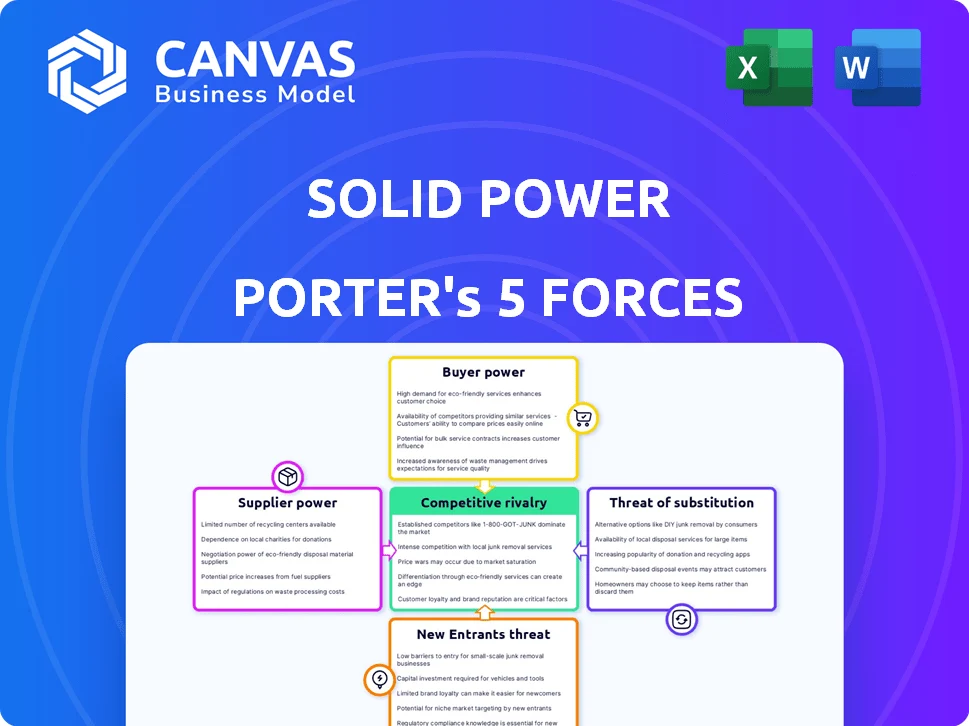
SOLID POWER PORTER'S FIVE FORCES TEMPLATE RESEARCH
What is included in the product
 Detailed Word Document
Tailored exclusively for Solid Power, analyzing its position within its competitive landscape.

 Customizable Excel Spreadsheet
Quickly assess competitive pressures with a dynamic, color-coded matrix.
Preview Before You Purchase
Solid Power Porter's Five Forces Analysis
This preview presents the full Solid Power Porter's Five Forces analysis. You'll receive the complete, professionally formatted document instantly after purchase. It details threats, rivalry, and more, ready for download. The analysis is the exact file shown here; no edits are necessary.

Porter's Five Forces Analysis Template

A Must-Have Tool for Decision-Makers
Solid Power faces moderate rivalry in the solid-state battery market, with strong competition from established players and emerging startups. Buyer power is currently limited due to high demand and limited supply. The threat of new entrants is moderate, fueled by technological advancements and government incentives. Supplier power is moderate, as raw material availability and pricing influence production. The threat of substitutes, such as liquid-ion batteries, is significant, posing a long-term challenge.
The complete report reveals the real forces shaping Solid Power’s industry—from supplier influence to threat of new entrants. Gain actionable insights to drive smarter decision-making.
Suppliers Bargaining Power

Limited Number of Suppliers for Key Raw Materials
Solid Power faces supplier power challenges due to reliance on few suppliers for key materials. This concentration, especially for lithium, cobalt, and nickel, allows suppliers to influence pricing. In 2024, lithium prices fluctuated significantly, impacting battery makers. Cobalt and nickel prices also saw volatility. This can raise Solid Power's production costs.
High Switching Costs for Alternative Materials
Switching to alternative materials or suppliers is costly. This includes R&D investments and other expenses, which makes it harder for Solid Power to change vendors. High switching costs empower suppliers. In 2024, material costs for battery manufacturing rose by 15%.

Potential for Suppliers to Integrate Forward
Some raw material suppliers are venturing into battery manufacturing, possibly becoming direct competitors. This forward integration threat increases their bargaining power over Solid Power. For example, in 2024, major lithium producers like Albemarle and SQM have expanded their downstream activities. This gives them leverage in price negotiations.

Supplier Concentration and Negotiation Power
The battery material market, especially for lithium-ion, is highly concentrated, with a few major suppliers controlling a large share. This gives these suppliers significant bargaining power over Solid Power. As of late 2024, the top three lithium suppliers control over 70% of the global market. This allows them to influence pricing and terms.
- Market concentration gives suppliers leverage.
- Pricing and terms are influenced by suppliers.
- Few suppliers control most of the market.
- Solid Power is vulnerable to supplier power.
Quality and Specialization of Materials
Suppliers of high-quality, specialized materials for solid-state batteries like Solid Power wield considerable bargaining power. Solid Power's reliance on these specialized suppliers is amplified by the unique demands of solid-state battery components. This dependence can affect pricing and supply chain stability. For instance, in 2024, the cost of lithium, a key material, fluctuated significantly, affecting battery production costs.
- Specialized materials lead to supplier power.
- Solid Power's dependency increases this power.
- Pricing and stability may be affected.
- Lithium cost fluctuations impact battery production.
Supplier Dynamics: Lithium's Grip on Battery Costs
Solid Power's supplier power is significant due to material concentration. Few suppliers control most of the market, affecting pricing and terms. Specialized materials further increase supplier leverage. In 2024, lithium prices fluctuated by 30%, impacting battery production costs.
| Factor | Impact | 2024 Data |
|---|---|---|
| Market Concentration | High Supplier Power | Top 3 Lithium Suppliers: 70%+ Market Share |
| Material Specialization | Increased Dependency | Lithium Price Fluctuation: 30% |
| Supplier Integration | Threat of Competition | Albemarle & SQM Expansion |
Customers Bargaining Power

Growing Demand for Electric Vehicles
The surge in electric vehicle (EV) demand globally significantly impacts the solid-state battery market. This demand boosts the need for advanced battery tech, providing leverage to customers like automakers. In 2024, EV sales are projected to reach about 14 million units worldwide. Automakers' crucial role in solid-state battery commercialization grants them bargaining power.
Availability of Alternatives
Customers have alternatives like lithium-ion batteries, which still dominate the market. In 2024, lithium-ion accounted for over 90% of the global battery market. This strong market presence gives customers significant leverage. If Solid Power's prices or performance lag, customers can easily choose competitors.

Large Automotive Manufacturers Hold Significant Purchasing Power
Major automotive OEMs, such as BMW and Ford, are crucial potential customers for Solid Power. These manufacturers possess significant bargaining power due to their substantial purchasing volumes. In 2024, Ford's revenue reached approximately $176.2 billion. Strategic partnerships further amplify their influence, enabling them to negotiate favorable terms and shape Solid Power's technological advancements.

Customers Seek Lower Prices and Increased Performance
Customers, particularly in the automotive industry, demand better battery performance at lower costs. This drives a constant search for batteries with higher energy density, faster charging capabilities, and enhanced safety features. Such requirements intensify the pressure on Solid Power, thereby increasing the bargaining power of customers. This dynamic is crucial for the company’s market positioning and strategic decisions.
- Automotive battery costs decreased by 8% in 2024.
- Energy density improvements in batteries reached 5% in 2024.
- The demand for faster charging batteries has increased by 10% in 2024.
Customer Feedback Driving Development
Solid Power's customer feedback loop is a key factor. They are sampling their solid-state electrolyte to potential customers and using their input to improve the product. This collaborative approach shows customers can shape product development. The company's strategy reflects a focus on meeting customer needs directly.
- Solid Power's 2024 revenue: $0.02 million.
- The company's net loss in 2024 was $105.3 million.
- Customer influence is vital for technology adaptation.
- Feedback helps tailor products to market demands.
Automakers' Grip: Solid Power's Customer Power
Customer bargaining power in Solid Power's market is significant, especially from automakers. Automakers' substantial purchasing volumes and strategic partnerships give them leverage in negotiating terms. In 2024, automotive battery costs decreased by 8%, reflecting customer pressure for better pricing. Solid Power's customer-focused feedback loop further enhances customer influence.
| Factor | Impact | 2024 Data |
|---|---|---|
| EV Demand | Boosts need for advanced batteries | ~14M EV sales globally |
| Alternative Tech | Customers have options | Li-ion >90% of market |
| Customer Influence | Shapes product development | Feedback-driven improvements |
Rivalry Among Competitors

Numerous Companies Racing to Commercialize Solid-State Batteries
The solid-state battery market is intensely competitive, with many players racing to commercialize this technology. Established battery makers, automakers, and startups are all competing fiercely. This competition significantly impacts Solid Power's market position. For example, companies like CATL and Toyota are heavily investing. In 2024, the global solid-state battery market was valued at approximately $130 million.
Competition from Improved Lithium-Ion Batteries
The competitive landscape includes advancements in lithium-ion batteries. Companies like CATL and BYD are consistently improving lithium-ion technology. In 2024, these batteries offer competitive energy densities and costs. This ongoing improvement poses a challenge for solid-state battery adoption, potentially delaying market penetration if advantages aren't clear.

Strategic Partnerships and Collaborations
Competitors are increasingly engaging in strategic partnerships to bolster their market presence. Solid Power's collaborations, like those with BMW and Ford, are vital for navigating this landscape. These partnerships help in sharing resources and expertise. For example, in 2024, BMW invested further in Solid Power. These partnerships help in sharing resources and expertise.

Different Technological Approaches
Competitive rivalry in solid-state batteries involves diverse technological paths. Solid Power's sulfide-based approach faces competition from those using different chemistries. These variations impact performance and manufacturing costs. In 2024, the solid-state battery market is projected to reach $1.1 billion.
- Different electrolyte materials create varied competitive landscapes.
- Companies like CATL and Samsung are investing heavily in different solid-state technologies.
- Manufacturing scalability and cost remain significant competitive factors.
- Overall, the industry's competitive dynamics are constantly evolving.
High Stakes and Potential for Disruption
The solid-state battery market is highly competitive, with the potential for significant disruption. Companies are aggressively vying for market share as they race to commercialize this transformative technology. This intense rivalry is fueled by the high stakes involved, with the potential for substantial financial gains and market leadership. In 2024, the global battery market was valued at $145 billion, and solid-state batteries are projected to capture a significant portion of this market in the coming years.
- Market Growth: The solid-state battery market is expected to reach $8 billion by 2030.
- Competitive Landscape: Over 50 companies are actively developing solid-state battery technologies.
- Funding: In 2024, over $3 billion was invested in solid-state battery research and development.
- Key Players: Major players include Solid Power, QuantumScape, and SK Innovation.
Solid-State Battery Race: $8 Billion by 2030!
The solid-state battery market is intensely competitive, with many players vying for market share. Established companies and startups are aggressively investing in this technology. This rivalry is fueled by the potential for substantial financial gains. In 2024, over 50 companies were developing solid-state batteries.
| Aspect | Details |
|---|---|
| Market Value (2024) | $130 million |
| Projected Market (2030) | $8 billion |
| R&D Investment (2024) | $3 billion |
Original: $10.00
-65%$10.00
$3.50Product Information
Product Information
Shipping & Returns
Shipping & Returns
Description
What is included in the product
Detailed Word Document
Tailored exclusively for Solid Power, analyzing its position within its competitive landscape.
Customizable Excel Spreadsheet
Quickly assess competitive pressures with a dynamic, color-coded matrix.
Preview Before You Purchase
Solid Power Porter's Five Forces Analysis
This preview presents the full Solid Power Porter's Five Forces analysis. You'll receive the complete, professionally formatted document instantly after purchase. It details threats, rivalry, and more, ready for download. The analysis is the exact file shown here; no edits are necessary.
Porter's Five Forces Analysis Template
A Must-Have Tool for Decision-Makers
Solid Power faces moderate rivalry in the solid-state battery market, with strong competition from established players and emerging startups. Buyer power is currently limited due to high demand and limited supply. The threat of new entrants is moderate, fueled by technological advancements and government incentives. Supplier power is moderate, as raw material availability and pricing influence production. The threat of substitutes, such as liquid-ion batteries, is significant, posing a long-term challenge.
The complete report reveals the real forces shaping Solid Power’s industry—from supplier influence to threat of new entrants. Gain actionable insights to drive smarter decision-making.
Suppliers Bargaining Power
Limited Number of Suppliers for Key Raw Materials
Solid Power faces supplier power challenges due to reliance on few suppliers for key materials. This concentration, especially for lithium, cobalt, and nickel, allows suppliers to influence pricing. In 2024, lithium prices fluctuated significantly, impacting battery makers. Cobalt and nickel prices also saw volatility. This can raise Solid Power's production costs.
High Switching Costs for Alternative Materials
Switching to alternative materials or suppliers is costly. This includes R&D investments and other expenses, which makes it harder for Solid Power to change vendors. High switching costs empower suppliers. In 2024, material costs for battery manufacturing rose by 15%.
Potential for Suppliers to Integrate Forward
Some raw material suppliers are venturing into battery manufacturing, possibly becoming direct competitors. This forward integration threat increases their bargaining power over Solid Power. For example, in 2024, major lithium producers like Albemarle and SQM have expanded their downstream activities. This gives them leverage in price negotiations.
Supplier Concentration and Negotiation Power
The battery material market, especially for lithium-ion, is highly concentrated, with a few major suppliers controlling a large share. This gives these suppliers significant bargaining power over Solid Power. As of late 2024, the top three lithium suppliers control over 70% of the global market. This allows them to influence pricing and terms.
- Market concentration gives suppliers leverage.
- Pricing and terms are influenced by suppliers.
- Few suppliers control most of the market.
- Solid Power is vulnerable to supplier power.
Quality and Specialization of Materials
Suppliers of high-quality, specialized materials for solid-state batteries like Solid Power wield considerable bargaining power. Solid Power's reliance on these specialized suppliers is amplified by the unique demands of solid-state battery components. This dependence can affect pricing and supply chain stability. For instance, in 2024, the cost of lithium, a key material, fluctuated significantly, affecting battery production costs.
- Specialized materials lead to supplier power.
- Solid Power's dependency increases this power.
- Pricing and stability may be affected.
- Lithium cost fluctuations impact battery production.
Supplier Dynamics: Lithium's Grip on Battery Costs
Solid Power's supplier power is significant due to material concentration. Few suppliers control most of the market, affecting pricing and terms. Specialized materials further increase supplier leverage. In 2024, lithium prices fluctuated by 30%, impacting battery production costs.
| Factor | Impact | 2024 Data |
|---|---|---|
| Market Concentration | High Supplier Power | Top 3 Lithium Suppliers: 70%+ Market Share |
| Material Specialization | Increased Dependency | Lithium Price Fluctuation: 30% |
| Supplier Integration | Threat of Competition | Albemarle & SQM Expansion |
Customers Bargaining Power
Growing Demand for Electric Vehicles
The surge in electric vehicle (EV) demand globally significantly impacts the solid-state battery market. This demand boosts the need for advanced battery tech, providing leverage to customers like automakers. In 2024, EV sales are projected to reach about 14 million units worldwide. Automakers' crucial role in solid-state battery commercialization grants them bargaining power.
Availability of Alternatives
Customers have alternatives like lithium-ion batteries, which still dominate the market. In 2024, lithium-ion accounted for over 90% of the global battery market. This strong market presence gives customers significant leverage. If Solid Power's prices or performance lag, customers can easily choose competitors.
Large Automotive Manufacturers Hold Significant Purchasing Power
Major automotive OEMs, such as BMW and Ford, are crucial potential customers for Solid Power. These manufacturers possess significant bargaining power due to their substantial purchasing volumes. In 2024, Ford's revenue reached approximately $176.2 billion. Strategic partnerships further amplify their influence, enabling them to negotiate favorable terms and shape Solid Power's technological advancements.
Customers Seek Lower Prices and Increased Performance
Customers, particularly in the automotive industry, demand better battery performance at lower costs. This drives a constant search for batteries with higher energy density, faster charging capabilities, and enhanced safety features. Such requirements intensify the pressure on Solid Power, thereby increasing the bargaining power of customers. This dynamic is crucial for the company’s market positioning and strategic decisions.
- Automotive battery costs decreased by 8% in 2024.
- Energy density improvements in batteries reached 5% in 2024.
- The demand for faster charging batteries has increased by 10% in 2024.
Customer Feedback Driving Development
Solid Power's customer feedback loop is a key factor. They are sampling their solid-state electrolyte to potential customers and using their input to improve the product. This collaborative approach shows customers can shape product development. The company's strategy reflects a focus on meeting customer needs directly.
- Solid Power's 2024 revenue: $0.02 million.
- The company's net loss in 2024 was $105.3 million.
- Customer influence is vital for technology adaptation.
- Feedback helps tailor products to market demands.
Automakers' Grip: Solid Power's Customer Power
Customer bargaining power in Solid Power's market is significant, especially from automakers. Automakers' substantial purchasing volumes and strategic partnerships give them leverage in negotiating terms. In 2024, automotive battery costs decreased by 8%, reflecting customer pressure for better pricing. Solid Power's customer-focused feedback loop further enhances customer influence.
| Factor | Impact | 2024 Data |
|---|---|---|
| EV Demand | Boosts need for advanced batteries | ~14M EV sales globally |
| Alternative Tech | Customers have options | Li-ion >90% of market |
| Customer Influence | Shapes product development | Feedback-driven improvements |
Rivalry Among Competitors
Numerous Companies Racing to Commercialize Solid-State Batteries
The solid-state battery market is intensely competitive, with many players racing to commercialize this technology. Established battery makers, automakers, and startups are all competing fiercely. This competition significantly impacts Solid Power's market position. For example, companies like CATL and Toyota are heavily investing. In 2024, the global solid-state battery market was valued at approximately $130 million.
Competition from Improved Lithium-Ion Batteries
The competitive landscape includes advancements in lithium-ion batteries. Companies like CATL and BYD are consistently improving lithium-ion technology. In 2024, these batteries offer competitive energy densities and costs. This ongoing improvement poses a challenge for solid-state battery adoption, potentially delaying market penetration if advantages aren't clear.
Strategic Partnerships and Collaborations
Competitors are increasingly engaging in strategic partnerships to bolster their market presence. Solid Power's collaborations, like those with BMW and Ford, are vital for navigating this landscape. These partnerships help in sharing resources and expertise. For example, in 2024, BMW invested further in Solid Power. These partnerships help in sharing resources and expertise.
Different Technological Approaches
Competitive rivalry in solid-state batteries involves diverse technological paths. Solid Power's sulfide-based approach faces competition from those using different chemistries. These variations impact performance and manufacturing costs. In 2024, the solid-state battery market is projected to reach $1.1 billion.
- Different electrolyte materials create varied competitive landscapes.
- Companies like CATL and Samsung are investing heavily in different solid-state technologies.
- Manufacturing scalability and cost remain significant competitive factors.
- Overall, the industry's competitive dynamics are constantly evolving.
High Stakes and Potential for Disruption
The solid-state battery market is highly competitive, with the potential for significant disruption. Companies are aggressively vying for market share as they race to commercialize this transformative technology. This intense rivalry is fueled by the high stakes involved, with the potential for substantial financial gains and market leadership. In 2024, the global battery market was valued at $145 billion, and solid-state batteries are projected to capture a significant portion of this market in the coming years.
- Market Growth: The solid-state battery market is expected to reach $8 billion by 2030.
- Competitive Landscape: Over 50 companies are actively developing solid-state battery technologies.
- Funding: In 2024, over $3 billion was invested in solid-state battery research and development.
- Key Players: Major players include Solid Power, QuantumScape, and SK Innovation.
Solid-State Battery Race: $8 Billion by 2030!
The solid-state battery market is intensely competitive, with many players vying for market share. Established companies and startups are aggressively investing in this technology. This rivalry is fueled by the potential for substantial financial gains. In 2024, over 50 companies were developing solid-state batteries.
| Aspect | Details |
|---|---|
| Market Value (2024) | $130 million |
| Projected Market (2030) | $8 billion |
| R&D Investment (2024) | $3 billion |