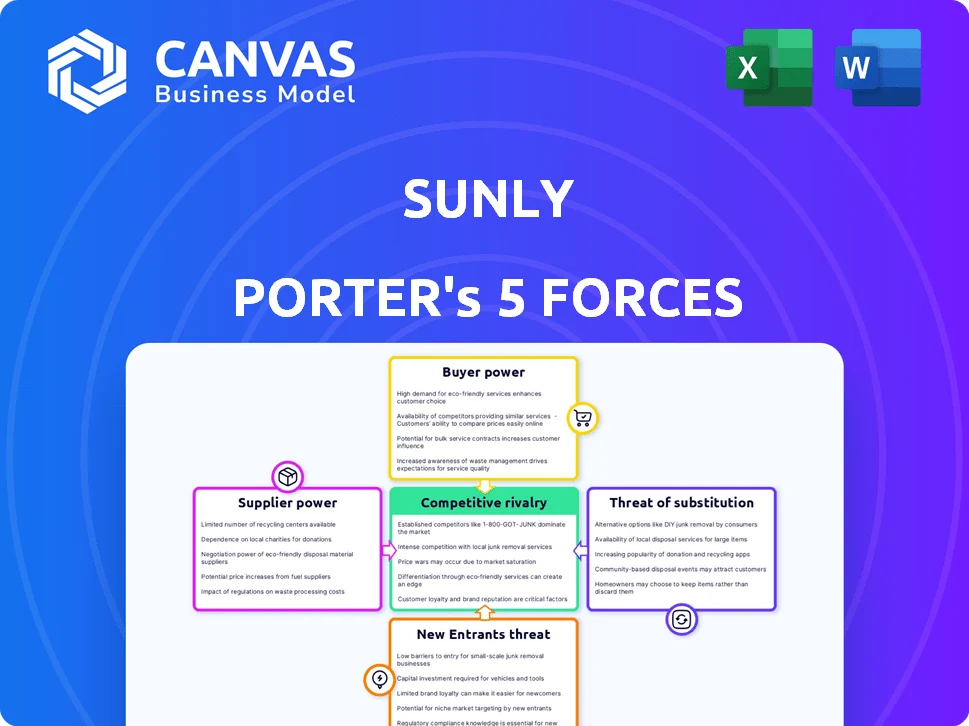
SUNLY PORTER'S FIVE FORCES TEMPLATE RESEARCH
What is included in the product
 Detailed Word Document
Analyzes Sunly's competitive position, evaluating supplier/buyer power, threats, and market entry.

 Customizable Excel Spreadsheet
Sunly Porter's simplifies analysis with interactive charts, revealing strategic pressures instantly.
Preview the Actual Deliverable
Sunly Porter's Five Forces Analysis
This preview presents Sunly Porter's Five Forces Analysis. The document you see is the complete analysis. Purchasing grants immediate access to this exact, ready-to-use file. There are no variations.

Porter's Five Forces Analysis Template

Don't Miss the Bigger Picture
Sunly's industry faces a complex interplay of competitive forces. Buyer power is moderate due to the concentration of institutional clients. Supplier power is limited by readily available raw materials. The threat of new entrants is moderate, with high capital requirements. The threat of substitutes is low, given the specialized nature of services. Rivalry among existing competitors is high, necessitating a strong value proposition.
Ready to move beyond the basics? Get a full strategic breakdown of Sunly’s market position, competitive intensity, and external threats—all in one powerful analysis.
Suppliers Bargaining Power

Limited number of specialized equipment manufacturers
The renewable energy sector depends on specialized equipment, like solar panels and inverters. The market for these components can be concentrated, giving suppliers bargaining power. In 2024, the top 10 solar panel manufacturers controlled over 70% of the global market. This can impact pricing and terms for companies like Sunly.
High switching costs for specialized equipment
Switching suppliers for specialized renewable energy equipment like solar panels or wind turbines is expensive. This includes the cost of new equipment, potential compatibility problems, and new operational procedures. For example, replacing a wind turbine can cost millions. This raises the bargaining power of suppliers.

Increasing demand for renewable energy
The rising demand for renewable energy worldwide, including in the Baltics, elevates suppliers' power. With demand for components and services exceeding supply, suppliers gain negotiating strength. For instance, the Baltic states are aiming for significant renewable energy capacity increases by 2030. This could lead to a sellers' market for key resources.

Availability of raw materials
The availability of raw materials significantly affects Sunly Porter's supplier power. Components like silicon and aluminum are essential, but their costs fluctuate. Rare earth minerals used in wind turbines face supply constraints, impacting costs for developers. These fluctuations directly influence project profitability.
- Silicon prices saw significant volatility in 2024.
- Aluminum prices increased by approximately 10% in the first half of 2024.
- Rare earth mineral prices remained high, with supply chain issues persisting.
- These price changes directly influenced project costs and profitability.
Technology advancements and proprietary technology
Suppliers with advanced tech and proprietary designs for renewable energy gear wield more power. This is especially true for tech boosting efficiency, making their components highly sought after. In 2024, the market for high-efficiency solar panels is growing rapidly. Suppliers with unique tech can command premium pricing.
- Advanced solar panel technology can increase the bargaining power of suppliers.
- The demand for high-efficiency components is rising.
- Specialized suppliers can set higher prices.
- R&D capabilities lead to competitive advantages.
Supplier Power Threatens Renewable Energy Projects
Sunly faces supplier bargaining power due to concentrated markets for renewable energy components. Switching costs for specialized equipment are high, further strengthening suppliers' position. Rising global demand, including in the Baltics, boosts suppliers' negotiating power.
Raw material price volatility, like silicon and aluminum, directly impacts project costs. Suppliers with advanced technology and proprietary designs can command premium pricing. The bargaining power of suppliers significantly affects Sunly Porter's profitability and project viability.
| Factor | Impact on Sunly | 2024 Data |
|---|---|---|
| Market Concentration | Higher costs, limited options | Top 10 solar panel makers controlled over 70% market share. |
| Switching Costs | Expensive, time-consuming | Replacing a wind turbine can cost millions. |
| Raw Material Prices | Project cost fluctuations | Silicon prices saw significant volatility; Aluminum +10% in H1. |
Customers Bargaining Power

Diverse customer base
Sunly's customer base spans businesses, communities, and possibly individual consumers, offering some protection. In 2024, diverse customer segments reduced the impact of any single client on Sunly's revenue. The spread of customers across various regions and sectors limits their ability to dictate pricing or terms. This diversification strengthens Sunly's market position.
Availability of alternative energy sources
Customers of Sunly Porter have several energy choices beyond their offerings, including fossil fuels and renewables like wind or hydro. This availability boosts customer bargaining power, especially if renewables aren't price-competitive. In 2024, the global renewable energy capacity increased, but fossil fuels still hold a significant market share. This gives customers leverage.

Government incentives and regulations
Government policies, incentives, and regulations are critical in influencing customer bargaining power within the renewable energy sector. For instance, in 2024, countries like Germany offered substantial feed-in tariffs, increasing customer adoption of solar power, effectively reducing their negotiation power. However, standardized regulations can limit negotiation options. The global renewable energy market is projected to reach $1.977.7 billion by 2030.

Access to information and price sensitivity
Customers’ access to energy prices and providers is growing. Transparency, especially for large users, boosts their negotiating power in PPAs. Increased price sensitivity further empowers customers in energy deals. This shift impacts Sunly Porter's market position, demanding competitive pricing.
- Energy price comparison websites are up 25% in usage.
- Industrial electricity users' cost sensitivity has risen by 18%.
- PPAs negotiated prices have decreased by an average of 7% in 2024.
Switching costs for customers
Switching costs for Sunly Porter's customers are relatively low, enhancing their bargaining power. Customers can switch providers easily, especially in liberalized markets, increasing their influence. This ease of switching can pressure Sunly Porter to maintain competitive pricing and service quality. The low switching costs mean customers have viable alternatives if they're dissatisfied.
- Energy markets are becoming increasingly competitive, with options like community solar and virtual power purchase agreements offering alternatives.
- In 2024, the average residential electricity price in the U.S. was around 16 cents per kilowatt-hour.
- Customer churn rates in the renewable energy sector can be influenced by factors like contract terms and pricing flexibility.
- Liberalized markets give customers the freedom to choose suppliers, which impacts their bargaining power.
Customer Power Dynamics in the Energy Sector
Sunly Porter's customers wield considerable power, influenced by energy choices and market dynamics. Diversification across customer segments in 2024 provided some protection, yet competitive pressures remain. Government policies and transparency further shape customer leverage.
| Aspect | Impact | 2024 Data |
|---|---|---|
| Energy Alternatives | High bargaining power | Fossil fuels still hold a significant market share, with renewables growing. |
| Price Sensitivity | Increased customer leverage | Industrial electricity users' cost sensitivity rose by 18%. |
| Switching Costs | Higher bargaining power | Energy markets are becoming increasingly competitive. |
Rivalry Among Competitors

Moderate number of competitors
The Baltic and surrounding renewable energy market features a moderate number of competitors. Sunly faces competition from other developers and operators. In 2024, the region saw increased investment in renewables. This led to heightened rivalry among companies. The market is dynamic, with new entrants and consolidation.
High market growth rate
The renewable energy market, especially in the Baltics, is experiencing high growth, driven by decarbonization and energy independence. This growth can accommodate multiple players, potentially moderating rivalry. For example, in 2024, the Baltic states saw a 20% increase in renewable energy capacity.

Differentiation based on technology and project implementation
Companies in renewable energy fiercely compete on project execution and technological advancements, beyond just cost. Sunly's approach, emphasizing hybrid projects that integrate solar, wind, and battery storage, sets it apart. This differentiation is crucial as it addresses the need for dependable, efficient energy solutions. In 2024, the global hybrid energy market is estimated to reach $20 billion.

Regional market dynamics
Competitive rivalry for Sunly Porter is shaped by regional market dynamics. Competition varies across the Baltics and Poland, with Lithuania experiencing faster solar power development, while Latvia is growing. This creates different competitive landscapes. The pace of solar adoption influences competitive intensity.
- Lithuania's solar capacity grew by 127% in 2023.
- Latvia's solar capacity increased by 80% in the same year.
- Poland's solar market is the largest, but with diverse regional competition.
Presence of larger, established energy companies
Sunly faces intense competition from established energy giants. These firms, like NextEra Energy and Enel, possess significant financial muscle and extensive infrastructure. In 2024, NextEra reported over $20 billion in revenue, showcasing their market dominance. This advantage allows them to invest heavily in renewable projects and customer acquisition. Such resources create a tough environment for smaller companies like Sunly.
- NextEra Energy's 2024 revenue exceeded $20 billion, showing their financial strength.
- Established companies have existing infrastructure and customer bases.
- These companies can invest more in renewable projects.
- Sunly must compete with firms like Enel and others transitioning to renewables.
Regional Solar Showdown: Baltics vs. Poland
Competitive rivalry for Sunly Porter is shaped by regional market dynamics. Competition varies across the Baltics and Poland, with Lithuania experiencing faster solar power development, while Latvia is growing. This creates different competitive landscapes. The pace of solar adoption influences competitive intensity.
| Metric | Lithuania | Latvia | Poland |
|---|---|---|---|
| Solar Capacity Growth (2023) | 127% | 80% | Largest Market |
| Key Competitors | Diverse | Growing | Established Giants |
| Market Dynamics | Fast-paced | Increasing | Competitive |
Original: $10.00
-65%$10.00
$3.50Product Information
Product Information
Shipping & Returns
Shipping & Returns
Description
What is included in the product
Detailed Word Document
Analyzes Sunly's competitive position, evaluating supplier/buyer power, threats, and market entry.
Customizable Excel Spreadsheet
Sunly Porter's simplifies analysis with interactive charts, revealing strategic pressures instantly.
Preview the Actual Deliverable
Sunly Porter's Five Forces Analysis
This preview presents Sunly Porter's Five Forces Analysis. The document you see is the complete analysis. Purchasing grants immediate access to this exact, ready-to-use file. There are no variations.
Porter's Five Forces Analysis Template
Don't Miss the Bigger Picture
Sunly's industry faces a complex interplay of competitive forces. Buyer power is moderate due to the concentration of institutional clients. Supplier power is limited by readily available raw materials. The threat of new entrants is moderate, with high capital requirements. The threat of substitutes is low, given the specialized nature of services. Rivalry among existing competitors is high, necessitating a strong value proposition.
Ready to move beyond the basics? Get a full strategic breakdown of Sunly’s market position, competitive intensity, and external threats—all in one powerful analysis.
Suppliers Bargaining Power
Limited number of specialized equipment manufacturers
The renewable energy sector depends on specialized equipment, like solar panels and inverters. The market for these components can be concentrated, giving suppliers bargaining power. In 2024, the top 10 solar panel manufacturers controlled over 70% of the global market. This can impact pricing and terms for companies like Sunly.
High switching costs for specialized equipment
Switching suppliers for specialized renewable energy equipment like solar panels or wind turbines is expensive. This includes the cost of new equipment, potential compatibility problems, and new operational procedures. For example, replacing a wind turbine can cost millions. This raises the bargaining power of suppliers.
Increasing demand for renewable energy
The rising demand for renewable energy worldwide, including in the Baltics, elevates suppliers' power. With demand for components and services exceeding supply, suppliers gain negotiating strength. For instance, the Baltic states are aiming for significant renewable energy capacity increases by 2030. This could lead to a sellers' market for key resources.
Availability of raw materials
The availability of raw materials significantly affects Sunly Porter's supplier power. Components like silicon and aluminum are essential, but their costs fluctuate. Rare earth minerals used in wind turbines face supply constraints, impacting costs for developers. These fluctuations directly influence project profitability.
- Silicon prices saw significant volatility in 2024.
- Aluminum prices increased by approximately 10% in the first half of 2024.
- Rare earth mineral prices remained high, with supply chain issues persisting.
- These price changes directly influenced project costs and profitability.
Technology advancements and proprietary technology
Suppliers with advanced tech and proprietary designs for renewable energy gear wield more power. This is especially true for tech boosting efficiency, making their components highly sought after. In 2024, the market for high-efficiency solar panels is growing rapidly. Suppliers with unique tech can command premium pricing.
- Advanced solar panel technology can increase the bargaining power of suppliers.
- The demand for high-efficiency components is rising.
- Specialized suppliers can set higher prices.
- R&D capabilities lead to competitive advantages.
Supplier Power Threatens Renewable Energy Projects
Sunly faces supplier bargaining power due to concentrated markets for renewable energy components. Switching costs for specialized equipment are high, further strengthening suppliers' position. Rising global demand, including in the Baltics, boosts suppliers' negotiating power.
Raw material price volatility, like silicon and aluminum, directly impacts project costs. Suppliers with advanced technology and proprietary designs can command premium pricing. The bargaining power of suppliers significantly affects Sunly Porter's profitability and project viability.
| Factor | Impact on Sunly | 2024 Data |
|---|---|---|
| Market Concentration | Higher costs, limited options | Top 10 solar panel makers controlled over 70% market share. |
| Switching Costs | Expensive, time-consuming | Replacing a wind turbine can cost millions. |
| Raw Material Prices | Project cost fluctuations | Silicon prices saw significant volatility; Aluminum +10% in H1. |
Customers Bargaining Power
Diverse customer base
Sunly's customer base spans businesses, communities, and possibly individual consumers, offering some protection. In 2024, diverse customer segments reduced the impact of any single client on Sunly's revenue. The spread of customers across various regions and sectors limits their ability to dictate pricing or terms. This diversification strengthens Sunly's market position.
Availability of alternative energy sources
Customers of Sunly Porter have several energy choices beyond their offerings, including fossil fuels and renewables like wind or hydro. This availability boosts customer bargaining power, especially if renewables aren't price-competitive. In 2024, the global renewable energy capacity increased, but fossil fuels still hold a significant market share. This gives customers leverage.
Government incentives and regulations
Government policies, incentives, and regulations are critical in influencing customer bargaining power within the renewable energy sector. For instance, in 2024, countries like Germany offered substantial feed-in tariffs, increasing customer adoption of solar power, effectively reducing their negotiation power. However, standardized regulations can limit negotiation options. The global renewable energy market is projected to reach $1.977.7 billion by 2030.
Access to information and price sensitivity
Customers’ access to energy prices and providers is growing. Transparency, especially for large users, boosts their negotiating power in PPAs. Increased price sensitivity further empowers customers in energy deals. This shift impacts Sunly Porter's market position, demanding competitive pricing.
- Energy price comparison websites are up 25% in usage.
- Industrial electricity users' cost sensitivity has risen by 18%.
- PPAs negotiated prices have decreased by an average of 7% in 2024.
Switching costs for customers
Switching costs for Sunly Porter's customers are relatively low, enhancing their bargaining power. Customers can switch providers easily, especially in liberalized markets, increasing their influence. This ease of switching can pressure Sunly Porter to maintain competitive pricing and service quality. The low switching costs mean customers have viable alternatives if they're dissatisfied.
- Energy markets are becoming increasingly competitive, with options like community solar and virtual power purchase agreements offering alternatives.
- In 2024, the average residential electricity price in the U.S. was around 16 cents per kilowatt-hour.
- Customer churn rates in the renewable energy sector can be influenced by factors like contract terms and pricing flexibility.
- Liberalized markets give customers the freedom to choose suppliers, which impacts their bargaining power.
Customer Power Dynamics in the Energy Sector
Sunly Porter's customers wield considerable power, influenced by energy choices and market dynamics. Diversification across customer segments in 2024 provided some protection, yet competitive pressures remain. Government policies and transparency further shape customer leverage.
| Aspect | Impact | 2024 Data |
|---|---|---|
| Energy Alternatives | High bargaining power | Fossil fuels still hold a significant market share, with renewables growing. |
| Price Sensitivity | Increased customer leverage | Industrial electricity users' cost sensitivity rose by 18%. |
| Switching Costs | Higher bargaining power | Energy markets are becoming increasingly competitive. |
Rivalry Among Competitors
Moderate number of competitors
The Baltic and surrounding renewable energy market features a moderate number of competitors. Sunly faces competition from other developers and operators. In 2024, the region saw increased investment in renewables. This led to heightened rivalry among companies. The market is dynamic, with new entrants and consolidation.
High market growth rate
The renewable energy market, especially in the Baltics, is experiencing high growth, driven by decarbonization and energy independence. This growth can accommodate multiple players, potentially moderating rivalry. For example, in 2024, the Baltic states saw a 20% increase in renewable energy capacity.
Differentiation based on technology and project implementation
Companies in renewable energy fiercely compete on project execution and technological advancements, beyond just cost. Sunly's approach, emphasizing hybrid projects that integrate solar, wind, and battery storage, sets it apart. This differentiation is crucial as it addresses the need for dependable, efficient energy solutions. In 2024, the global hybrid energy market is estimated to reach $20 billion.
Regional market dynamics
Competitive rivalry for Sunly Porter is shaped by regional market dynamics. Competition varies across the Baltics and Poland, with Lithuania experiencing faster solar power development, while Latvia is growing. This creates different competitive landscapes. The pace of solar adoption influences competitive intensity.
- Lithuania's solar capacity grew by 127% in 2023.
- Latvia's solar capacity increased by 80% in the same year.
- Poland's solar market is the largest, but with diverse regional competition.
Presence of larger, established energy companies
Sunly faces intense competition from established energy giants. These firms, like NextEra Energy and Enel, possess significant financial muscle and extensive infrastructure. In 2024, NextEra reported over $20 billion in revenue, showcasing their market dominance. This advantage allows them to invest heavily in renewable projects and customer acquisition. Such resources create a tough environment for smaller companies like Sunly.
- NextEra Energy's 2024 revenue exceeded $20 billion, showing their financial strength.
- Established companies have existing infrastructure and customer bases.
- These companies can invest more in renewable projects.
- Sunly must compete with firms like Enel and others transitioning to renewables.
Regional Solar Showdown: Baltics vs. Poland
Competitive rivalry for Sunly Porter is shaped by regional market dynamics. Competition varies across the Baltics and Poland, with Lithuania experiencing faster solar power development, while Latvia is growing. This creates different competitive landscapes. The pace of solar adoption influences competitive intensity.
| Metric | Lithuania | Latvia | Poland |
|---|---|---|---|
| Solar Capacity Growth (2023) | 127% | 80% | Largest Market |
| Key Competitors | Diverse | Growing | Established Giants |
| Market Dynamics | Fast-paced | Increasing | Competitive |