VECTRA NETWORKS PORTER'S FIVE FORCES TEMPLATE RESEARCH
What is included in the product
 Detailed Word Document
Analyzes Vectra Networks' position, identifying competitive threats & influences on pricing/profit.

 Customizable Excel Spreadsheet
Understand Vectra's competitive forces at a glance with a dynamic, one-sheet summary.
Preview the Actual Deliverable
Vectra Networks Porter's Five Forces Analysis
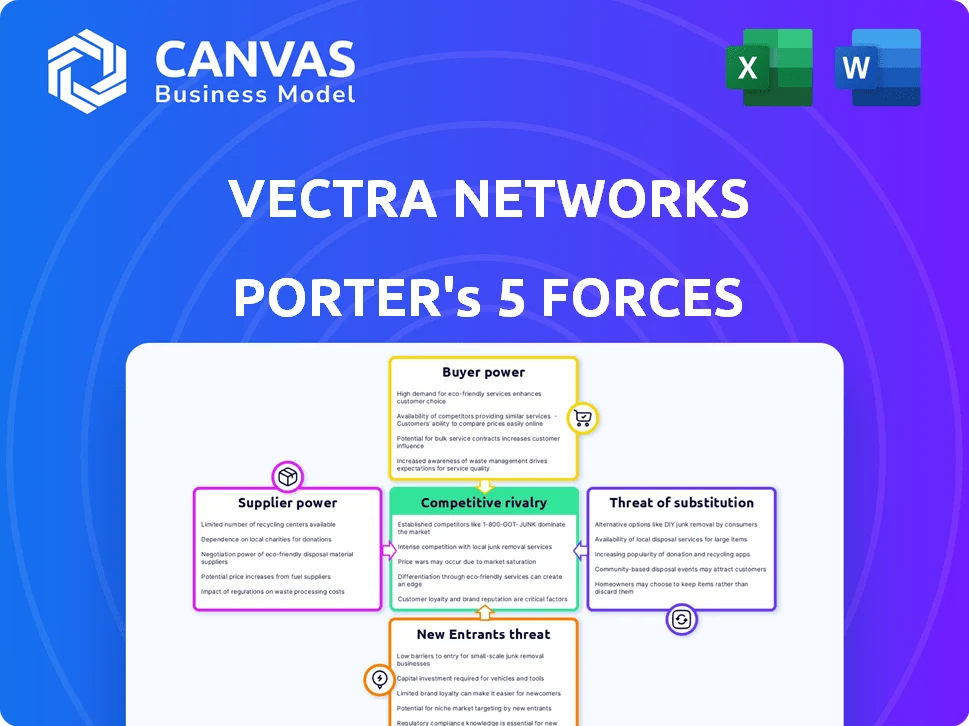
This is the comprehensive Porter's Five Forces analysis of Vectra Networks. The preview details the competitive landscape, including threat of new entrants, bargaining power of suppliers, and other factors. You’ll receive this same detailed report immediately after purchasing. The analysis is ready to use, providing a complete overview.

Porter's Five Forces Analysis Template

Don't Miss the Bigger Picture
Vectra Networks operates in a cybersecurity market with moderate rivalry, intensified by established players and innovative startups. Bargaining power of suppliers is generally low due to diverse technology sources. Buyer power is moderate, influenced by diverse customer needs and contract negotiations. The threat of new entrants is significant, fueled by technological advancements and venture capital. Substitute threats are also moderate, with alternative security solutions emerging.
This brief snapshot only scratches the surface. Unlock the full Porter's Five Forces Analysis to explore Vectra Networks’s competitive dynamics, market pressures, and strategic advantages in detail.
Suppliers Bargaining Power

Dependence on key technologies
Vectra AI's platform heavily depends on advanced AI and machine learning technologies. Suppliers of specialized hardware like GPUs, crucial for AI, could wield power, especially if their offerings are unique. For example, in 2024, NVIDIA controlled about 70% of the discrete GPU market. The availability of AI tools is growing, potentially reducing supplier influence.
Availability of skilled personnel
The cybersecurity field's reliance on skilled personnel, like data scientists and engineers, is significant. The demand for these experts is high, but their availability is limited. This scarcity gives these professionals leverage in salary negotiations and work conditions. This can increase operational costs for companies like Vectra AI. In 2024, cybersecurity salaries rose by an average of 7% due to this talent shortage.

Reliance on data sources
Vectra AI's platform relies heavily on data to detect threats. The availability and quality of this data are key to its success. Suppliers of data feeds or network infrastructure access could exert some influence. However, the diversity of data sources may limit any single supplier's power. In 2024, the cybersecurity market is estimated at $200 billion, showing the importance of data.

Third-party software and integrations
Vectra AI's integration with other security tools gives suppliers some leverage. These suppliers, like endpoint protection or SIEM providers, can exert influence. Their importance to Vectra AI's offerings or high switching costs enhance their power. For example, the cybersecurity market was valued at $202.4 billion in 2023.
- Critical integrations increase supplier bargaining power.
- Switching costs can further strengthen supplier influence.
- The cybersecurity market's value supports this dynamic.
- Suppliers with unique or essential integrations hold more sway.
Hardware component providers
Vectra AI, while focused on software and AI, depends on hardware. Suppliers of servers and networking gear can exert power, especially for on-premises setups. The bargaining power is moderate, as Vectra can choose from multiple hardware vendors. However, specialized hardware needs might increase supplier influence. In 2024, the global server market was valued at over $100 billion, showing the scale of this sector.
- Hardware costs can significantly impact Vectra's operational expenses.
- Switching costs between hardware vendors can be a factor.
- Dependence on specific hardware for optimal performance.
- Availability and lead times for critical components.
Cybersecurity Market Dynamics: Supplier Power
Suppliers' power varies based on integration and uniqueness. Critical integrations give suppliers leverage over Vectra AI. High switching costs enhance supplier influence within the cybersecurity market. In 2024, the cybersecurity market reached $210 billion.
| Aspect | Impact | Example |
|---|---|---|
| Integration | Increases power | Endpoint protection providers |
| Switching Costs | Strengthens influence | High vendor change costs |
| Market Value | Supports the dynamic | $210B cybersecurity market (2024) |
Customers Bargaining Power

Availability of alternatives
Customers have many cybersecurity options, like NDR and XDR platforms, increasing their bargaining power. The cybersecurity market was valued at $223.8 billion in 2023, showing the wide array of choices. With numerous competitors, customers can negotiate prices and demand better service. This competitive landscape means vendors must offer value to attract and retain clients.
Switching costs
Switching costs are a critical factor in customer bargaining power. Implementing and integrating a new cybersecurity platform, like Vectra Networks, requires significant investment. High switching costs, such as data migration and retraining, can reduce customer bargaining power. For instance, a 2024 study showed that the average cost to switch cybersecurity vendors was $75,000.

Customer size and concentration
Vectra AI's customer base includes both large enterprises and small to medium-sized businesses (SMBs). If a significant portion of Vectra AI's revenue comes from a few major clients, those customers could wield considerable bargaining power. For instance, if 30% of sales are from one client, that client could negotiate aggressively. In 2024, the cybersecurity market saw increased price sensitivity, potentially amplifying customer bargaining power.

Importance of cybersecurity
Cybersecurity is paramount for all organizations, especially as cyberattacks become more sophisticated. This critical need empowers customers, making them more demanding regarding value and effectiveness, thus increasing their bargaining power. In 2024, the average cost of a data breach hit $4.45 million globally, highlighting the stakes. Customers now scrutinize security measures more closely, seeking robust solutions.
- Increased cybersecurity demands drive customer expectations.
- Data breach costs influence customer bargaining power.
- Customers prioritize value and effectiveness in security.
- Organizations must offer strong security to retain customers.
Access to information and evaluations
Customers of Vectra Networks, like those in the cybersecurity sector, wield significant power due to readily available information. This access to data, including independent reviews and competitive analyses, allows them to compare Vectra's offerings against rivals. This comparison shopping capability strengthens their ability to negotiate favorable pricing and contract terms, directly impacting Vectra's profitability. The cybersecurity market's competitive landscape, with numerous vendors, further amplifies customer bargaining power.
- In 2024, the cybersecurity market is estimated at $202.8 billion, with projections to reach $279.7 billion by 2027, indicating a highly competitive environment where customers have many choices.
- Websites like Gartner and Forrester provide detailed vendor evaluations, which are crucial for customer decision-making, increasing their bargaining leverage.
- Studies show that 70% of B2B buyers research vendors online before making a purchase, emphasizing the impact of information availability on customer decisions.
Cybersecurity Market: Customer Power Dynamics
Customers in the cybersecurity market, including those evaluating Vectra Networks, possess substantial bargaining power. The market's estimated value in 2024 is $202.8 billion, with projections to reach $279.7 billion by 2027. This growth fuels competition, giving customers numerous choices and leverage.
| Factor | Impact | Data |
|---|---|---|
| Market Competition | High | $202.8B (2024) to $279.7B (2027) |
| Information Availability | Significant | 70% B2B buyers research online |
| Switching Costs | Moderate | Avg. switch cost: $75,000 (2024) |
Rivalry Among Competitors

Number and diversity of competitors
The cybersecurity market, especially in AI-driven threat detection, is fiercely competitive. Vectra AI competes with many firms, including industry leaders and AI startups. This high number of rivals increases competition. The global cybersecurity market was valued at $223.8 billion in 2023.
Market growth rate
The AI in cybersecurity market is booming, with an expected value of $46.4 billion in 2024. Rapid growth can initially ease rivalry, providing space for companies like Vectra AI to thrive. However, this attracts new competitors, potentially intensifying competition. The market is projected to reach $133.6 billion by 2029, increasing the stakes for all players.

Product differentiation
Vectra AI aims to stand out with its AI-driven Attack Signal Intelligence. This helps it compete with rivals. Competitors also use AI and detection, creating a challenge. In 2024, the cybersecurity market grew, but differentiation remains key. The global cybersecurity market was valued at $223.8 billion in 2023, and is projected to reach $345.4 billion by 2028.

Switching costs for customers
Switching costs play a crucial role in competitive rivalry. High switching costs reduce rivalry as customers stay put. Yet, attractive competitor offers can still heighten competition. For example, in 2024, the cybersecurity market saw intense rivalry, with firms battling to offer superior value, even with customer loyalty.
- High switching costs often diminish rivalry.
- Compelling offers can still intensify competition.
- The cybersecurity market is a good example.
- Firms compete for customer loyalty.
Aggressiveness of competitors
Competitors in cybersecurity, like Palo Alto Networks and CrowdStrike, are known for aggressive marketing. Their pricing and promotional strategies are highly competitive. This intense rivalry affects Vectra Networks' market position. The cybersecurity market is expected to reach $267.3 billion by 2028.
- Aggressive pricing wars are common.
- Intense promotional campaigns.
- Customer acquisition is a top priority.
- Market share battles are fierce.
Cybersecurity's $345.4B Battleground: Fierce Rivalry!
Competitive rivalry in cybersecurity is intense, with numerous firms vying for market share. The global cybersecurity market hit $223.8B in 2023, driving aggressive competition. This includes marketing and pricing strategies.
| Aspect | Details | Impact on Vectra AI |
|---|---|---|
| Market Growth | Projected to $345.4B by 2028 | Increased competition; need for differentiation |
| Competitor Strategies | Aggressive marketing, pricing | Pressure on pricing, customer acquisition |
| Switching Costs | Can reduce rivalry, but attractive offers intensify it | Vectra AI must provide superior value |
Original: $10.00
-65%$10.00
$3.50Product Information
Product Information
Shipping & Returns
Shipping & Returns
Description
What is included in the product
Detailed Word Document
Analyzes Vectra Networks' position, identifying competitive threats & influences on pricing/profit.
Customizable Excel Spreadsheet
Understand Vectra's competitive forces at a glance with a dynamic, one-sheet summary.
Preview the Actual Deliverable
Vectra Networks Porter's Five Forces Analysis
This is the comprehensive Porter's Five Forces analysis of Vectra Networks. The preview details the competitive landscape, including threat of new entrants, bargaining power of suppliers, and other factors. You’ll receive this same detailed report immediately after purchasing. The analysis is ready to use, providing a complete overview.
Porter's Five Forces Analysis Template
Don't Miss the Bigger Picture
Vectra Networks operates in a cybersecurity market with moderate rivalry, intensified by established players and innovative startups. Bargaining power of suppliers is generally low due to diverse technology sources. Buyer power is moderate, influenced by diverse customer needs and contract negotiations. The threat of new entrants is significant, fueled by technological advancements and venture capital. Substitute threats are also moderate, with alternative security solutions emerging.
This brief snapshot only scratches the surface. Unlock the full Porter's Five Forces Analysis to explore Vectra Networks’s competitive dynamics, market pressures, and strategic advantages in detail.
Suppliers Bargaining Power
Dependence on key technologies
Vectra AI's platform heavily depends on advanced AI and machine learning technologies. Suppliers of specialized hardware like GPUs, crucial for AI, could wield power, especially if their offerings are unique. For example, in 2024, NVIDIA controlled about 70% of the discrete GPU market. The availability of AI tools is growing, potentially reducing supplier influence.
Availability of skilled personnel
The cybersecurity field's reliance on skilled personnel, like data scientists and engineers, is significant. The demand for these experts is high, but their availability is limited. This scarcity gives these professionals leverage in salary negotiations and work conditions. This can increase operational costs for companies like Vectra AI. In 2024, cybersecurity salaries rose by an average of 7% due to this talent shortage.
Reliance on data sources
Vectra AI's platform relies heavily on data to detect threats. The availability and quality of this data are key to its success. Suppliers of data feeds or network infrastructure access could exert some influence. However, the diversity of data sources may limit any single supplier's power. In 2024, the cybersecurity market is estimated at $200 billion, showing the importance of data.
Third-party software and integrations
Vectra AI's integration with other security tools gives suppliers some leverage. These suppliers, like endpoint protection or SIEM providers, can exert influence. Their importance to Vectra AI's offerings or high switching costs enhance their power. For example, the cybersecurity market was valued at $202.4 billion in 2023.
- Critical integrations increase supplier bargaining power.
- Switching costs can further strengthen supplier influence.
- The cybersecurity market's value supports this dynamic.
- Suppliers with unique or essential integrations hold more sway.
Hardware component providers
Vectra AI, while focused on software and AI, depends on hardware. Suppliers of servers and networking gear can exert power, especially for on-premises setups. The bargaining power is moderate, as Vectra can choose from multiple hardware vendors. However, specialized hardware needs might increase supplier influence. In 2024, the global server market was valued at over $100 billion, showing the scale of this sector.
- Hardware costs can significantly impact Vectra's operational expenses.
- Switching costs between hardware vendors can be a factor.
- Dependence on specific hardware for optimal performance.
- Availability and lead times for critical components.
Cybersecurity Market Dynamics: Supplier Power
Suppliers' power varies based on integration and uniqueness. Critical integrations give suppliers leverage over Vectra AI. High switching costs enhance supplier influence within the cybersecurity market. In 2024, the cybersecurity market reached $210 billion.
| Aspect | Impact | Example |
|---|---|---|
| Integration | Increases power | Endpoint protection providers |
| Switching Costs | Strengthens influence | High vendor change costs |
| Market Value | Supports the dynamic | $210B cybersecurity market (2024) |
Customers Bargaining Power
Availability of alternatives
Customers have many cybersecurity options, like NDR and XDR platforms, increasing their bargaining power. The cybersecurity market was valued at $223.8 billion in 2023, showing the wide array of choices. With numerous competitors, customers can negotiate prices and demand better service. This competitive landscape means vendors must offer value to attract and retain clients.
Switching costs
Switching costs are a critical factor in customer bargaining power. Implementing and integrating a new cybersecurity platform, like Vectra Networks, requires significant investment. High switching costs, such as data migration and retraining, can reduce customer bargaining power. For instance, a 2024 study showed that the average cost to switch cybersecurity vendors was $75,000.
Customer size and concentration
Vectra AI's customer base includes both large enterprises and small to medium-sized businesses (SMBs). If a significant portion of Vectra AI's revenue comes from a few major clients, those customers could wield considerable bargaining power. For instance, if 30% of sales are from one client, that client could negotiate aggressively. In 2024, the cybersecurity market saw increased price sensitivity, potentially amplifying customer bargaining power.
Importance of cybersecurity
Cybersecurity is paramount for all organizations, especially as cyberattacks become more sophisticated. This critical need empowers customers, making them more demanding regarding value and effectiveness, thus increasing their bargaining power. In 2024, the average cost of a data breach hit $4.45 million globally, highlighting the stakes. Customers now scrutinize security measures more closely, seeking robust solutions.
- Increased cybersecurity demands drive customer expectations.
- Data breach costs influence customer bargaining power.
- Customers prioritize value and effectiveness in security.
- Organizations must offer strong security to retain customers.
Access to information and evaluations
Customers of Vectra Networks, like those in the cybersecurity sector, wield significant power due to readily available information. This access to data, including independent reviews and competitive analyses, allows them to compare Vectra's offerings against rivals. This comparison shopping capability strengthens their ability to negotiate favorable pricing and contract terms, directly impacting Vectra's profitability. The cybersecurity market's competitive landscape, with numerous vendors, further amplifies customer bargaining power.
- In 2024, the cybersecurity market is estimated at $202.8 billion, with projections to reach $279.7 billion by 2027, indicating a highly competitive environment where customers have many choices.
- Websites like Gartner and Forrester provide detailed vendor evaluations, which are crucial for customer decision-making, increasing their bargaining leverage.
- Studies show that 70% of B2B buyers research vendors online before making a purchase, emphasizing the impact of information availability on customer decisions.
Cybersecurity Market: Customer Power Dynamics
Customers in the cybersecurity market, including those evaluating Vectra Networks, possess substantial bargaining power. The market's estimated value in 2024 is $202.8 billion, with projections to reach $279.7 billion by 2027. This growth fuels competition, giving customers numerous choices and leverage.
| Factor | Impact | Data |
|---|---|---|
| Market Competition | High | $202.8B (2024) to $279.7B (2027) |
| Information Availability | Significant | 70% B2B buyers research online |
| Switching Costs | Moderate | Avg. switch cost: $75,000 (2024) |
Rivalry Among Competitors
Number and diversity of competitors
The cybersecurity market, especially in AI-driven threat detection, is fiercely competitive. Vectra AI competes with many firms, including industry leaders and AI startups. This high number of rivals increases competition. The global cybersecurity market was valued at $223.8 billion in 2023.
Market growth rate
The AI in cybersecurity market is booming, with an expected value of $46.4 billion in 2024. Rapid growth can initially ease rivalry, providing space for companies like Vectra AI to thrive. However, this attracts new competitors, potentially intensifying competition. The market is projected to reach $133.6 billion by 2029, increasing the stakes for all players.
Product differentiation
Vectra AI aims to stand out with its AI-driven Attack Signal Intelligence. This helps it compete with rivals. Competitors also use AI and detection, creating a challenge. In 2024, the cybersecurity market grew, but differentiation remains key. The global cybersecurity market was valued at $223.8 billion in 2023, and is projected to reach $345.4 billion by 2028.
Switching costs for customers
Switching costs play a crucial role in competitive rivalry. High switching costs reduce rivalry as customers stay put. Yet, attractive competitor offers can still heighten competition. For example, in 2024, the cybersecurity market saw intense rivalry, with firms battling to offer superior value, even with customer loyalty.
- High switching costs often diminish rivalry.
- Compelling offers can still intensify competition.
- The cybersecurity market is a good example.
- Firms compete for customer loyalty.
Aggressiveness of competitors
Competitors in cybersecurity, like Palo Alto Networks and CrowdStrike, are known for aggressive marketing. Their pricing and promotional strategies are highly competitive. This intense rivalry affects Vectra Networks' market position. The cybersecurity market is expected to reach $267.3 billion by 2028.
- Aggressive pricing wars are common.
- Intense promotional campaigns.
- Customer acquisition is a top priority.
- Market share battles are fierce.
Cybersecurity's $345.4B Battleground: Fierce Rivalry!
Competitive rivalry in cybersecurity is intense, with numerous firms vying for market share. The global cybersecurity market hit $223.8B in 2023, driving aggressive competition. This includes marketing and pricing strategies.
| Aspect | Details | Impact on Vectra AI |
|---|---|---|
| Market Growth | Projected to $345.4B by 2028 | Increased competition; need for differentiation |
| Competitor Strategies | Aggressive marketing, pricing | Pressure on pricing, customer acquisition |
| Switching Costs | Can reduce rivalry, but attractive offers intensify it | Vectra AI must provide superior value |










